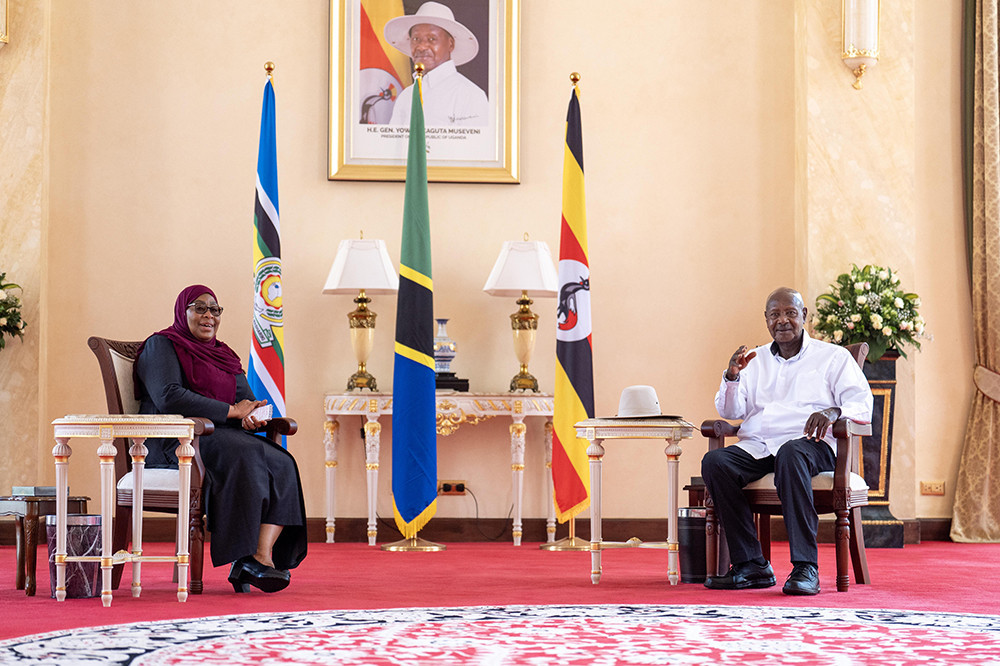
Uganda and Tanzania have agreed to accelerate major energy and transport projects, seeking to deepen regional trade and industrial cooperation. The commitments followed talks between Ugandan President Yoweri Museveni and Tanzanian President Samia Suluhu Hassan in Entebbe on November 18, during the Tanzanian leader’s state visit to Uganda.
The two presidents welcomed progress on the East African Crude Oil Pipeline (EACOP), which they said was 93.9% complete, according to the joint communiqué issued after their meeting. They called for the remaining construction, testing, commissioning and operational readiness activities to be expedited before crude oil transportation begins. The 1,443-kilometer pipeline is designed to carry Ugandan crude from the Lake Albert oilfields through Tanzania to an export terminal near Tanga.
The leaders also called for faster implementation of an August 2026 memorandum of understanding on developing Tanga into a Regional Energy Hub. The agreement, signed by Uganda National Oil Company, Tanzania Petroleum Development Corporation and Vitol Bahrain E.C., provides for cooperation on petroleum storage, refining, trading, distribution and logistics, according to Uganda’s Ministry of Foreign Affairs.
On railway connectivity, the presidents welcomed the signing of a framework agreement for the Isaka–Lusahunga–Murongo/Kikagati–Mpondwe Standard Gauge Railway project. They directed the responsible ministries, railway authorities and other institutions to advance feasibility studies, technical designs and financing arrangements. The agreement does not mean that construction financing has already been secured.
The leaders also called for faster development of a 400-kilovolt electricity interconnector between the two countries. In June 2026, the World Bank approved $250 million in concessional financing for Uganda’s section of the Uganda–Tanzania Interconnector Project. The funding forms part of a wider $1.6 billion regional energy programme.
The discussions also covered persistent non-tariff trade barriers, improvements to Lake Victoria transport links and the need to turn existing bilateral commitments into practical results.
The meeting highlighted the two governments’ push to build a more integrated regional energy and transport network, although the projects remain at different stages of implementation.