There is a particular kind of cruelty in an Ebola outbreak that strikes a province already under siege by an Islamist militia, because the two crises don't just coexist — they actively feed each other. In Ituri, eastern Congo, that is exactly what's happening, and a month into the response, it is no longer clear which threat is making the other one worse.
The numbers alone would be alarming in a stable country. As of June 17, the Democratic Republic of Congo has confirmed 837 Ebola cases and 196 deaths, the overwhelming majority in Ituri, with smaller clusters spreading into North and South Kivu and across the border into Uganda. This is the Bundibugyo strain — rarer and, crucially, not covered by the vaccine that helped contain the country's previous Ebola epidemics. There is, as of this month, no approved vaccine or treatment for it at all.
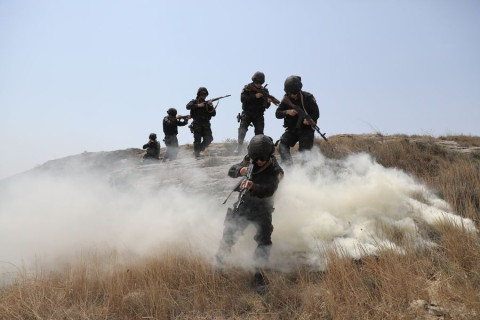
Ituri is not a stable province. It's a militarized administrative zone where the Allied Democratic Forces, a Ugandan-rooted militia now operating under the Islamic State's regional banner, has spent the past month carrying out its deadliest campaign against civilians there since 2022 — researchers at ACLED count at least 149 civilian deaths in May alone, matching four months of ADF violence compressed into one. The militia's stated targets are mining communities and supply routes; the outbreak's epicenter happens to sit on top of the same gold-mining towns, including Mongbwalu, where ADF activity has intensified.
When the cure looks like the threat
The collision isn't just geographic. Containment work itself has become a flashpoint. In Mongbwalu, a burial team was attacked and five outbreak responders were reportedly taken hostage after being accused of spreading the disease. Earlier in the response, residents in Rwampara set fire to treatment tents after a dispute over whether a death was actually Ebola or typhoid; in the same week, eighteen suspected patients fled a facility that had come under attack. Each incident chips away at the same thing: a population's willingness to let contact tracers and health workers near them at all. The World Health Organization's own contact-tracing coverage sits around 45%, well short of the 90% threshold it considers necessary to actually break a chain of transmission.
WHO Director-General Tedros Adhanom Ghebreyesus put the underlying problem about as bluntly as a UN official ever does, telling reporters that contact tracing and isolating the sick become nearly impossible while armed violence continues. It is not a coincidence that the outbreak is concentrated in one of the only parts of the DRC where the state, MONUSCO peacekeepers and now the WHO are all simultaneously trying — and struggling — to project authority over the same square kilometers.
A funding gap that won't close itself
The international response has been fast by historical standards: the US has committed over $200 million, the UK pledged up to £20 million, the EU added €15 million, and four vaccine candidates are now in development, including ones from Moderna and Oxford. But roughly $287 million of an agreed $319 million response budget remains unsecured, and money alone doesn't solve the access problem. You cannot vaccinate your way out of an epidemic in villages your health workers can't safely reach.
That's the part worth watching past the headline case counts. Ituri's last comparable Ebola crisis, in 2018-2020, took nearly two years to fully extinguish, largely because of the exact same combination now repeating itself — an active insurgency, a distrustful population, and a health system trying to do epidemiology in a war zone. The difference this time is that the militia driving the insecurity is having its bloodiest month in years at the precise moment containment needs to be at its most aggressive. Neither crisis is going to wait for the other to be resolved first