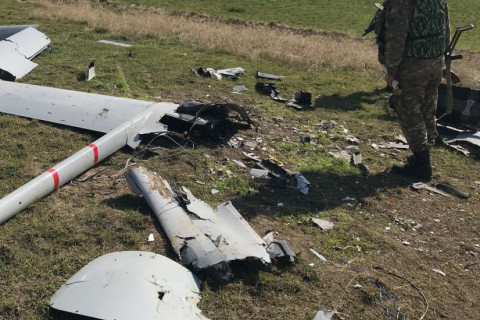
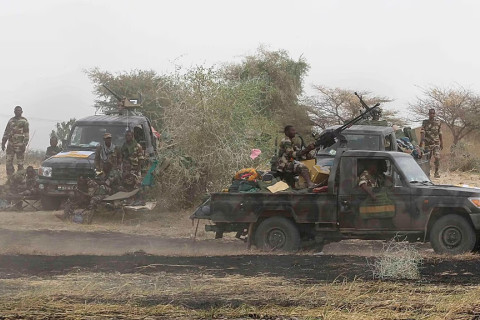
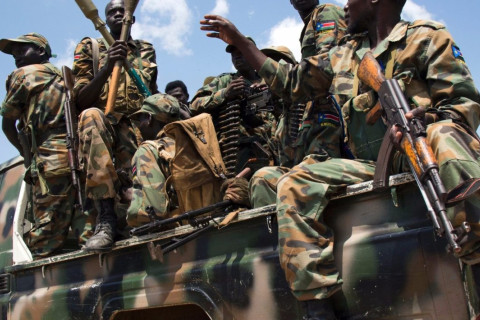
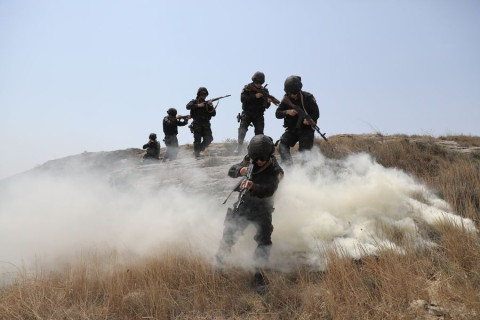
In February 2026, a joint Congolese-Ugandan strike force destroyed what military intelligence assessed as a strategically significant ADF command-and-logistics camp in eastern DRC. The operation was a success by every measurable metric. Within weeks, ADF fighters had re-infiltrated the area. This has happened, in one form or another, following virtually every major engagement since Operation Shujaa — the joint FARDC-UPDF campaign — launched in 2021. What military planners are only now being forced to acknowledge publicly is that the group being defeated in each of these operations is not the same group that keeps returning.
The Allied Democratic Forces — formally recognised by the Islamic State in 2020 as its Central Africa Province, ISCAP — has spent the past eighteen months undergoing what analysts at the Institute for Security Studies now describe as a strategic mutation. The core shift: sustained military pressure has produced not degradation but dispersal. Areas cleared of ADF fighters are re-infiltrated within weeks, not because the group has unlimited manpower, but because it has developed a succession architecture that replaces neutralised commanders faster than they can be eliminated, and a geographic expansion strategy that turns military pressure in its traditional strongholds into operational opportunity elsewhere.
The Haut-Uélé move
The most significant indicator of this mutation is the group's documented movement into Haut-Uélé province — far to the north of its traditional operating zones in Beni, Lubero and Ituri. This is not a retreat. Analysts at African Security Analysis, who flagged the development in a 26 May report, describe it as a "significant strategic development": ADF/ISCAP is "no longer operating only as a threat concentrated around its traditional zones in Beni, Ituri and adjacent forest corridors." Congolese research institute Ebuteli — which tracks ADF activity on the ground — identifies two drivers of this expansion: geographic dispersal as a response to sustained military pressure, and a deliberate tactical transition away from fixed strongholds toward mobile, decentralised cells that are far harder to target and harder to monitor.
Haut-Uélé sits at the convergence of the DRC, CAR and South Sudan borders — an under-governed, lightly monitored triple-frontier zone with no significant FARDC or UN peacekeeping presence. The ADF has been building networks there for at least two years, and the group's documented interest in recruiting beyond its traditional Ugandan Muslim base — toward local Congolese populations and transnational networks — gives the province's ethnic and cross-border dynamics a new security dimension they didn't previously carry.
The economic engine that military strikes can't reach
One reason Operation Shujaa has failed to weaken the ADF structurally is that it targets the group's fighters while leaving its financial model largely intact. According to Ebuteli's research, in March 2026 alone a record 544 civilians were abducted in Mambasa territory — more than 400 of them by the ADF — with ransoms running between $2,500 and $10,000 per person. That is a single month's snapshot of an operation that has been running continuously. More abductions may indicate financial stress, analysts note, but they also demonstrate operational capacity: a group under genuine existential pressure does not run record kidnapping campaigns.
Beyond ransom, the ADF taxes farming communities in areas under its influence, extracts value from artisanal gold mining in Lubero territory, and maintains supply and logistics networks that have proven resilient to interdiction. The Islamic State's financial support adds a layer of external resourcing that is structurally independent of whatever happens on any given battlefield. Each of these revenue streams would need to be targeted simultaneously and sustainably to produce financial pressure significant enough to affect the group's operational capacity. No current counter-terrorism architecture in the DRC is designed to do that.
The M23 dividend
The timing of the ADF's expansion into Haut-Uélé is not coincidental. The M23 crisis — which has consumed the majority of FARDC's operational attention since early 2025, including the redeployment of units that had previously been assigned to counter-ADF operations — has provided the group with exactly the kind of strategic breathing space it needed to consolidate new positions. UN Security Council discussions on June 9, which covered both UNOCA's assessment of the broader Central African security environment and the LRA's ongoing presence in the region, noted explicitly that ADF activities in the northeast were intensifying precisely as the DRC's military focus shifted westward toward Ituri and southward toward the Kivus.
The M23 ceasefire process — with talks expected to resume in Switzerland following a postponement in early June due to a "lack of consensus on agenda and negotiation schedule," according to Africa Intelligence — offers a theoretical opening. If Kinshasa and M23 reach a durable arrangement, FARDC units could theoretically be redeployed northward. But the Washington Peace Accords of November 2025, which created the current framework, have so far produced two US sanctions packages against Rwanda and continued fighting, not a stable ceasefire. The military bandwidth required to address ADF/ISCAP's expansion into Haut-Uélé does not currently exist, and it will not exist as long as the eastern DRC remains militarily contested across three provinces simultaneously.
Why this matters beyond the DRC
The Haut-Uélé expansion has a specific regional implication that goes beyond Congolese security: it brings ADF/ISCAP into direct proximity with CAR, where Russia's Africa Corps and MINUSCA are managing a separate and fragile stabilisation process, and with South Sudan, which is already monitoring Ebola cases near the DRC border at Ingbokolo. A jihadist group with Islamic State affiliation establishing a durable presence in the DRC-CAR-South Sudan triple frontier zone would represent a qualitative change in the regional threat environment — not just an expansion of an existing local insurgency, but the potential seeding of an IS-linked network in one of the least-governed spaces in Central Africa.
Five years of Operation Shujaa have demonstrated that military operations can displace the ADF from specific locations and kill specific commanders. They have not demonstrated that military operations alone can degrade the group's will or capacity to operate. The ADF's movement into Haut-Uélé is the clearest possible signal that the group has absorbed that lesson and drawn its own conclusions from it.