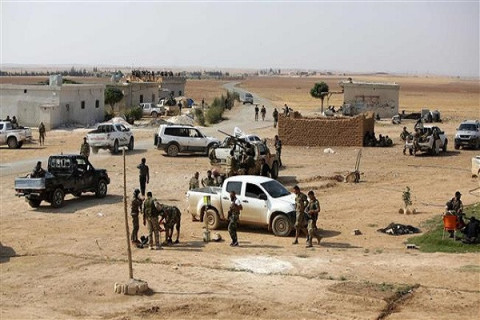
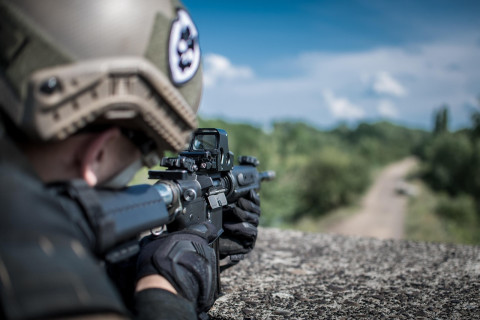
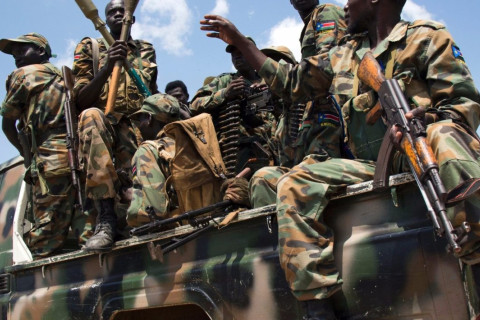
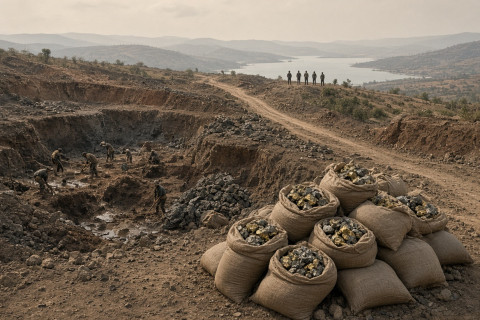
Virunga National Park has been closed to tourists since January 2025, when M23 fighters seized Goma and the surrounding area in eastern DRC. Africa's oldest national park — established in 1925, home to roughly a third of the world's remaining mountain gorillas, a UNESCO World Heritage Site listed as in danger — has no reopening date. The 700 rangers who remained on the ground did not leave. They continued operating in a park where their primary challenge is no longer poaching. It is an active armed conflict involving a rebel coalition backed by a neighboring state. This is what conservation looks like in Central Africa in 2026. Not just rangers protecting endangered species from poachers, but rangers operating inside active conflict zones, protecting landscapes that armed groups use to finance themselves — through illegal mining, charcoal production, timber extraction, and wildlife trafficking — and that governments need to control precisely because of what happens when they don't.
The economic logic of the forest
To understand why protected areas have become strategic space, it helps to follow the money. Virunga's forests contain gold, coltan, and timber. Illegal charcoal production inside the park has been estimated by WWF at $35-40 million annually — more than the park's entire conservation budget. For armed groups, a national park is not a wilderness to be preserved. It is a revenue source to be taxed or extracted, and the denser and more remote the terrain, the more useful it is as both a logistics corridor and a sanctuary from military pressure. The pattern repeats across the region. In Garamba National Park in northeastern DRC — once home to the last northern white rhinos on Earth, now functionally eliminated — poaching networks overlap with cross-border criminal supply chains connecting DRC, South Sudan, and Sudan. In Cameroon's Lobéké National Park, on the border with the Republic of Congo and CAR, traffickers move ivory, pangolin scales, and bushmeat through the same informal routes used for weapons and illicit minerals, documented by TRAFFIC and the Wildlife Justice Commission in successive reports. The illegal wildlife economy in Central Africa is not a separate underworld from the security threats that governments are managing. It is part of the same infrastructure.
Four parks, four different realities
Grouping Central Africa's protected areas as a single category obscures how differently this dynamic plays out on the ground. Virunga is the acute case: a functioning park administration operating in active conflict, with M23 controlling access to significant portions of the park perimeter, UNESCO requesting state-party reports that the DRC government has repeatedly failed to submit, and 14.2% of the property encroached by human settlement. The security situation, as UNESCO's 2025 State of Conservation assessment puts it, "deteriorated significantly again in early 2025," affecting not only Virunga but also Kahuzi-Biega National Park and the Okapi Wildlife Reserve.
Dzanga-Sangha in CAR is a different story — arguably one of the most extraordinary wildlife spectacles in the world, where forest elephants gather daily in a forest clearing in the extreme southwest of the country. It has remained functional precisely because it sits far enough from the conflict zones that dominate the north and center of the country, and because WWF has co-managed it in partnership with the government since 1990, building a model of community integration that insulates the reserve from some of the dynamics affecting parks elsewhere. In November 2025, CAR President Touadéra attended the first-ever Dzanga-Sangha Day in Bangui, a national event that would have been politically inconceivable a decade ago. The same country that hosts Africa Corps fighters — the rebranded successor to Wagner, which by mid-2025 had replaced its predecessor's personnel in CAR — also has a functioning conservation programme that international partners describe as a genuine success. Both things are true. Lobéké in Cameroon and Nouabalé-Ndoki in the Republic of Congo represent a third mode: formally functional, internationally supported, but operating under pressure from cross-border trafficking networks and with community tensions that no amount of ranger equipment can resolve if the underlying economic grievances remain unaddressed.
Who does conservation, and in whose interest
The militarization of conservation has consequences for the communities living around protected areas that are rarely discussed in the same reports that celebrate ranger deployments and anti-poaching operations. In Virunga, communities living on the park's perimeter have historically had access to forest resources — firewood, small-scale farming, fishing — that ranger enforcement increasingly restricts. When a park becomes a counterinsurgency space, the distinction between protecting wildlife and controlling territory blurs, and local communities bear the cost of that blurring most directly. In CAR, the Dzanga-Sangha model has tried to address this structurally. BaAka communities — Indigenous forest peoples whose knowledge of the forest is fundamental to conservation operations — are employed as guides, trackers, and conservation staff, with tourism revenue shared with local communities. The model generates approximately $1 million annually from tourism alone, which funds not only conservation but healthcare and education infrastructure in the surrounding villages. It is, as former reserve director Luis Arranz described it, a demonstration that conservation only works when local people have concrete reasons to want it to work. That model requires stability to function. In Virunga, stability is not available. In Garamba, it has been absent for decades. The question for international partners — WWF, WCS, the EU's ECOFAC programme, the US Fish and Wildlife Service — is whether the community-integration model developed in Dzanga-Sangha can be transferred to parks operating in active conflict environments, or whether it depends on a baseline security that those environments cannot provide.
What changed, and when
Conservation in Central Africa did not suddenly become a security issue. The relationship between protected areas and armed conflict in the region runs back to the 1990s, when the aftermath of the Rwandan genocide pushed armed groups into the Virunga massif and the dynamics of militarized parks began to take shape. What has changed in 2025 and 2026 is the scale and complexity of the convergence: M23 backed by Rwanda operating in DRC's most internationally recognized park, Africa Corps replacing Wagner in a country where the same Russian-affiliated actors who extract timber through shell companies are also providing presidential protection, and wildlife trafficking networks that international law enforcement bodies now treat as organized crime with direct links to arms supply chains. The UNESCO World Heritage Committee's decision to keep Virunga on its List of World Heritage in Danger — a listing it has held since 1994 — is the clearest formal signal of where this has led. The park has survived colonial extraction, post-independence instability, the LRA, the FDLR, the ADF, and two M23 rebellions. Whether it survives the current one, with its mountain gorillas intact and its community relationships functional, will depend on decisions made far outside the park's boundaries — in Kinshasa, in Kigali, in Washington, and in the peace talks that have so far produced ceasefire announcements and continued fighting in roughly equal measure.