Ethiopia’s army chief has escalated accusations against Eritrea, alleging that Asmara is coordinating armed groups and regional powers to destabilize the country.
Field Marshal Birhanu Jula, chief of the General Staff of the Ethiopian National Defense Forces, made the remarks on November 14 during his first visit to Mekelle since federal forces retook the Tigrayan capital on October 3, according to the Namibian Broadcasting Corporation.
He described Eritrea’s government as a “problem” and accused it of supporting the Tigray People’s Liberation Front (TPLF), the Amhara Fano National Movement, the Oromo Liberation Army, Sudan and Egypt in what he called a coordinated effort to “bury Ethiopia.”
Birhanu said Eritrea had helped create “Tsimdo,” a Tigrinya term for engagement, launched in May 2025 between Eritrea and Ethiopia’s Tigray region under the stated aim of improving cooperation among border communities. Ethiopia’s government instead characterizes it as an “anti-Ethiopia” movement.
He alleged that Eritrea wanted to turn Tigray into a battleground to protect itself from an Ethiopian push for Red Sea access, while also destabilizing Amhara and seeking to change Ethiopia’s government.
Birhanu also said as many as 800,000 Tigrayan youths had left the region for Addis Ababa, Adama, Dire Dawa, Hawassa, Asosa and Gambela to avoid forced conscription—an assertion that remains unverified.
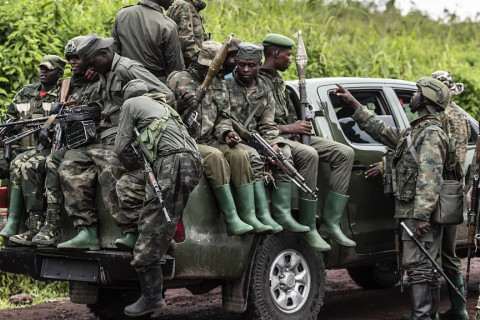
The TPLF has described its withdrawal from Mekelle and other towns as a strategic retreat rather than defeat, while residents report continued artillery exchanges, drone strikes and fighting in central, northern and north-western Tigray.
Fighting has also been reported near the Eritrean border, including around Sheraro and Badme, where the Ethiopian army and Tigray Defense Forces have clashed in recent weeks. The renewed TPLF offensive began in September 2026 and resulted in at least 277 battle-related deaths before federal forces regained most territory.
The accusations come amid a separate dispute over Ethiopia’s access to the Red Sea. Ethiopian Navy commander Vice-Admiral Kindu Gezu said Ethiopia would pursue access through diplomacy and law, but warned that “other alternatives” could follow if those efforts failed.
Kindu went further, saying Ethiopia’s demand concerned ownership of territory rather than merely port access, and that war would become “inevitable” if diplomacy failed. He singled out Assab, Eritrea’s Red Sea port, as a central objective.
In turn, Eritrea said its sovereignty, independence and territorial integrity are not negotiable “under any circumstances.” The exchange has heightened fears that the Tigray conflict and the Assab dispute could merge into a broader Ethiopia-Eritrea confrontation. The two countries have had no diplomatic ties since October 1, and competing allegations of military mobilization and cross-border activity continue to fuel uncertainty.