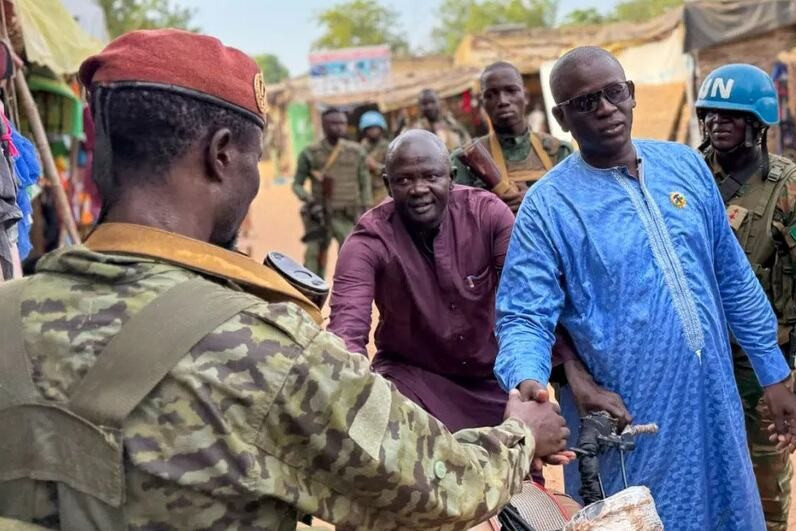
The United Nations has warned against a premature withdrawal of peacekeepers from the Central African Republic (CAR), saying the war in neighboring Sudan is spilling across the border and threatening hard-won stability.
The appeal came as the Security Council prepares to decide whether to renew the mandate of the UN mission, MINUSCA, before it expires on November 15.
Valentine Rugwabiza, the UN Secretary-General’s Special Representative for CAR and head of MINUSCA, told Council members on 20 October that violence in the country’s east was intensifying despite progress in disarmament and the completion of much of the electoral cycle.
She urged the Council to maintain the mission’s “adequate force levels and capabilities” during what she described as a critical consolidation phase.
Rugwabiza pointed to a June 30 attack on Am-Dafock, near the Sudanese border, by armed groups that killed civilians and security personnel, displaced 17,000 people and injured six UN peacekeepers.
She said MINUSCA’s rapid response prevented greater loss of life and enabled state authority to be restored after armed fighters had controlled the town for five days before retreating into Sudan.
The UN says the conflict in Sudan has increased cross-border incursions and insecurity in CAR’s northeast, particularly in Vakaga prefecture. Denmark’s UN statement likewise warned that arms movements and armed build-ups in the area were deepening concern about regional spillover.
UN Secretary-General António Guterres recommended a one-year extension while preserving the mission’s capacity for rapid intervention. MINUSCA, deployed in 2014 after the Séléka rebellion triggered years of violence, currently maintains more than 12,000 peacekeepers.
While Bangui has expanded state authority and more than 1,900 fighters have been disarmed and demobilised since July 2025, insecurity persists in the east and southeast. The UN recorded 26 serious incidents attributed to suspected Lord’s Resistance Army fighters between June and September, including sexual violence and the abduction of 68 civilians, about 40 of them children.
The Azandé Ani Kpi Gbé militia also continues to threaten communities, although Rugwabiza announced the release of three hostages held since December 2025, including the sub-prefect of Bambouti.
The United States welcomed MINUSCA’s transfer of security, corrections and electoral responsibilities to national institutions, but cautioned that a static peacekeeping presence should not become permanent. Washington called on CAR authorities to accelerate security-sector reform and develop timely transition plans.
Addressing the UN Security Council meeting on the Central African Republic on October 20, Jess Jambert-Gray, UK Deputy Political Coordinator, supported a transition, but said it must be “gradual, conditions-based, carefully sequenced, and guided by realities on the ground.”
She also highlighted the regional dimension of the crisis, noting that more than 416,000 people are internally displaced and around two million face food insecurity.
Nearly two million Central Africans, 31% of the population, faced acute food insecurity between April and August, while the UN humanitarian response plan was only 46.6% funded at the start of October.