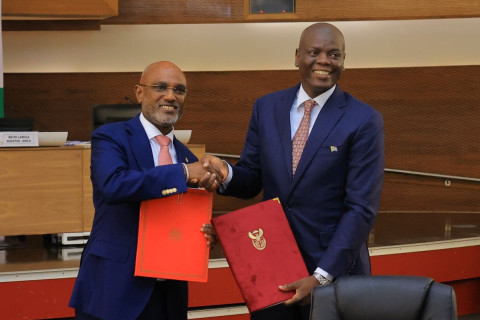
India's presence in Africa is often overshadowed by China's large infrastructure projects or the Gulf states' investments in ports and logistics. In Gabon, however, New Delhi is quietly pursuing a different strategy. Rather than focusing on headline-grabbing megaprojects, India is expanding through sectors that support the country's long-term economic transformation: mining, pharmaceuticals, telecommunications, manufacturing, education, and technical cooperation. This diversified approach has made India one of Gabon's most significant Asian economic partners, with cumulative Indian public and private investment estimated at approximately US$2.5 billion.
Beyond Oil: A Broader Investment Portfolio
Although hydrocarbons remain an important part of bilateral trade, India's footprint in Gabon extends well beyond energy. Indian companies are active across telecommunications, mining, pharmaceuticals, wood processing, agriculture, infrastructure, and manufacturing. Major investors include Bharti Airtel, Oil India Limited (OIL), AFCONS Infrastructure, La Santé Pharma, Greenply, Nouvelle Gabon Mining, NMDC, MOIL, and SAIL. Together, they illustrate a strategy centered on commercial diversification rather than concentration in a single sector.
Mining has become one of the most dynamic areas of cooperation. Gabon, the world's second-largest producer of manganese, has attracted sustained interest from Indian mining companies seeking long-term supply partnerships rather than outright ownership of strategic assets. In August 2025, a delegation representing MOIL, SAIL, and NMDC visited Libreville to discuss investment opportunities with Gabon's ministries of mines and foreign affairs. The discussions built on earlier MOIL visits in 2024, underscoring India's long-term interest in the country's mineral sector. Cooperation continues to deepen. In early 2026, Gabon's Minister of Mines accepted an invitation to participate in a major industry conference in New Delhi focused on steel, heavy industry, and investment opportunities, reflecting growing interest in developing local mineral processing rather than exporting raw materials alone.
Skills, Medicines, and Connectivity
Unlike many external partners whose engagement is concentrated in physical infrastructure, India has invested heavily in human capital. Scholarships under the Indian Technical and Economic Cooperation (ITEC) programme and the Indian Council for Cultural Relations (ICCR) continue to provide training opportunities for Gabonese officials, engineers, and students in fields ranging from information technology to public administration. These programmes receive far less attention than infrastructure investments but create long-term institutional links between the two countries.
Healthcare represents another important pillar of cooperation. Indian pharmaceutical companies have steadily expanded their presence in Gabon, supplying affordable generic medicines while gradually increasing local commercial operations. Companies such as La Santé Pharma have become part of Gabon's broader healthcare ecosystem as demand for medical products continues to rise.
Telecommunications provide a third illustration of India's long-term approach. Since acquiring Zain's African operations in 2010, Bharti Airtel has remained one of the country's largest private investors, demonstrating that Indian engagement is not limited to extractive industries but also extends into consumer services and digital connectivity.
A Different Model of Engagement
The structure of India's relationship with Gabon differs noticeably from that of several larger external actors. China's engagement has largely centered on infrastructure construction and public financing. European partners remain particularly active in forestry, energy transition, and governance programmes. India's comparative advantage instead lies in sectors where it possesses internationally competitive private companies and technical expertise. This approach does not eliminate competition. Indian firms still compete with companies from Europe, China, and the Gulf for commercial opportunities. Yet the emphasis is different: rather than building entirely new economic ecosystems, India is embedding itself within sectors already supporting Gabon's industrial development. That strategy may prove increasingly relevant as Libreville seeks to diversify its economy beyond hydrocarbons and expand domestic processing of strategic minerals.
Ultimately, India's partnership with Gabon illustrates that influence in Africa is no longer measured solely by the size of infrastructure projects. Increasingly, it is also built through skills, industrial partnerships, healthcare, and technology—areas where long-term commercial relationships can become just as valuable as roads, ports, or pipelines.