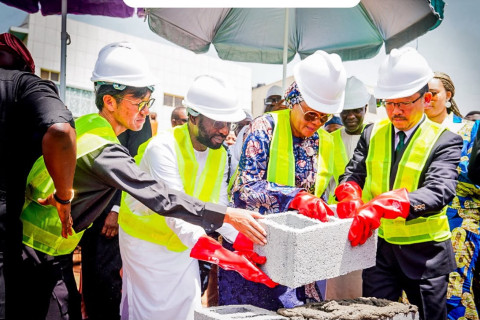
Rwanda and China have officially launched the road construction linking Prince House, Giporoso and Masaka in Kigali, strengthening connectivity across the capital and toward eastern trade corridors.
The China-aided scheme covers roughly 10.3 km and transforms a mixed two- and four-lane corridor into a higher-capacity urban artery. The first 1.37 km will be reconfigured into an interchange layout, while the remaining 9.04 km will be reconstructed and widened from a two-lane, two-way road into a four-lane, two-way carriageway, the Rwanda-based KT Press reported on September 8.
The works include an elevated overpass, an underpass tunnel, bridges, drainage systems and street lighting, which the Chinese ambassador described as introducing Rwanda’s first modern “three-dimensional” urban transport system on this route.
Financing is structured as a grant from Beijing, with Chinese support estimated at approximately $64.6 million and Rwanda contributing about $23.8 million, which includes over $20.4 million already disbursed for expropriation along the corridor. The project's total funding envelope stands at roughly $88.4 million.
Although the construction contract allows 30 months for completion starting from late August 2026, Rwandan authorities are urging the contractor, Hunan Road and Bridge Construction Group Co., Ltd., to deliver the project in under 20 months due to the corridor's vital role in daily commuter transit and regional freight movement.
Rwandan State Minister for Infrastructure Col. Claudien Bizimungu said the upgraded road will significantly improve traffic flow, reduce travel time, enhance road safety and strengthen connectivity across Kigali, while also improving access to jobs, markets and essential services.
Once complete, the corridor is expected to link central Kigali more efficiently with the Kigali Special Economic Zone, the Eastern Industrial Zone, the Masaka Medical Complex and surrounding communities, and to connect with major eastward routes toward seaports and the future Bugesera International Airport. The road will cut logistics and transportation costs and deliver tangible public-welfare benefits to residents.
Framed as a concrete deliverable of high-level Rwanda–China ties, the road project is presented as a key livelihood initiative under the Belt and Road Initiative, a tangible outcome of the Forum on China-Africa Cooperation Beijing Summit’s action plan, and a direct implementation of the infrastructure cooperation agreed by the heads of state of the two countries.