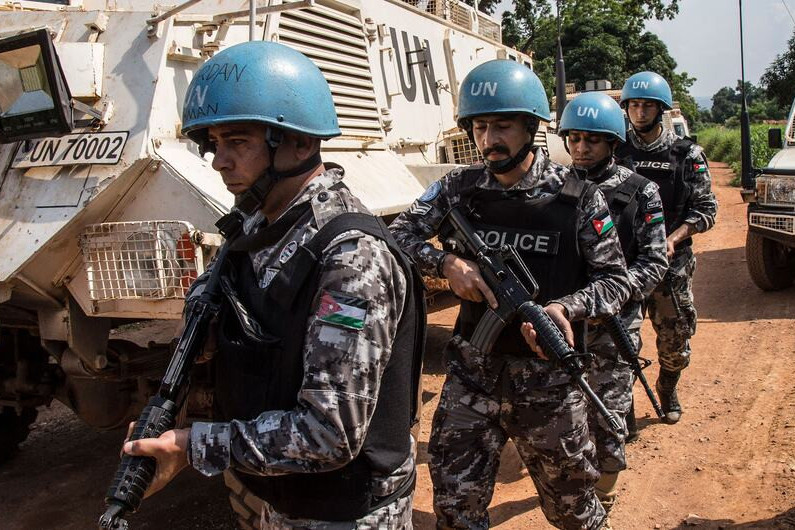
Portuguese peacekeepers with the UN mission in the Central African Republic (MINUSCA) have concluded a long-range patrol in the commune of Lambi, about 150 km from Bangui, aimed at strengthening presence, assessing security and maintaining direct dialogue with residents.
The operation, carried out from September 9–11 by the contingent’s Rapid Reaction Force, included meetings with local authorities, community leaders and civilians to document concerns over civilian protection, freedom of movement and access to essential services, according to APA News.
During the mission, troops visited Bodiki town hall, where discussions centered on insecurity in parts of the commune, the deterioration of road infrastructure and the impact on daily life.
Local councillor Prospère Mongouanoua Kolo identified security as a top municipal priority, reporting the presence of fighters from the armed group Retour, Réclamation et Réhabilitation (3R) in several villages and alleging their involvement in incidents with residents.
He also highlighted the impassable bridge in Pama village, warning that poor roads hinder defence and security forces from intervening effectively to protect Lambi and surrounding communities.
Kolo called for accelerating disarmament, demobilization and reintegration (DDR) for 3R elements in the area to reduce risks to civilians.
Youth representative Roméo Ouabangué pointed to an insufficient number of Central African Armed Forces (FACA) and gendarmerie personnel, as well as limited logistical resources, and urged authorities to reinforce FACA’s staffing and operational capacity to improve protection.
For Corporal Prestana of the Rapid Reaction Force, the patrol’s purpose was to establish a military presence, support the population and, when necessary, deter armed groups. MINUSCA says such deployments are intended to consolidate its footprint away from the capital, strengthen community dialogue and contribute to civilian protection and stabilization efforts.
In a separate development, CAR authorities have deployed troops to eastern Mbomou Prefecture after at least 30 people, including 13 children, were abducted in attacks attributed to the Lord’s Resistance Army (LRA). The assaults, reported on September 12, targeted three villages near Bangassou and primarily affected fishing and hunting communities. Bangassou MP Frédéric Kinza said 44 people were initially taken, with 31 later released and 13 children still in captivity.
The LRA, founded by warlord Joseph Kony, has been accused of killings, abductions and the forced recruitment of children, and is believed to retain small, isolated cells in remote border areas despite being significantly weakened. The incidents raise concerns that the LRA could be rebuilding a presence in southeastern CAR, where communities already face violence and kidnappings by other armed groups, including the Azande Ani Kpi Gbe (AAKG) militia.
Over the past two decades, the African Union has deployed at least 28 missions, shifting from non-interference to active conflict intervention. While celebrated as "African solutions," these missions face serious hurdles, including heavy financial dependence on international donors, limited resources, and coordination gaps.