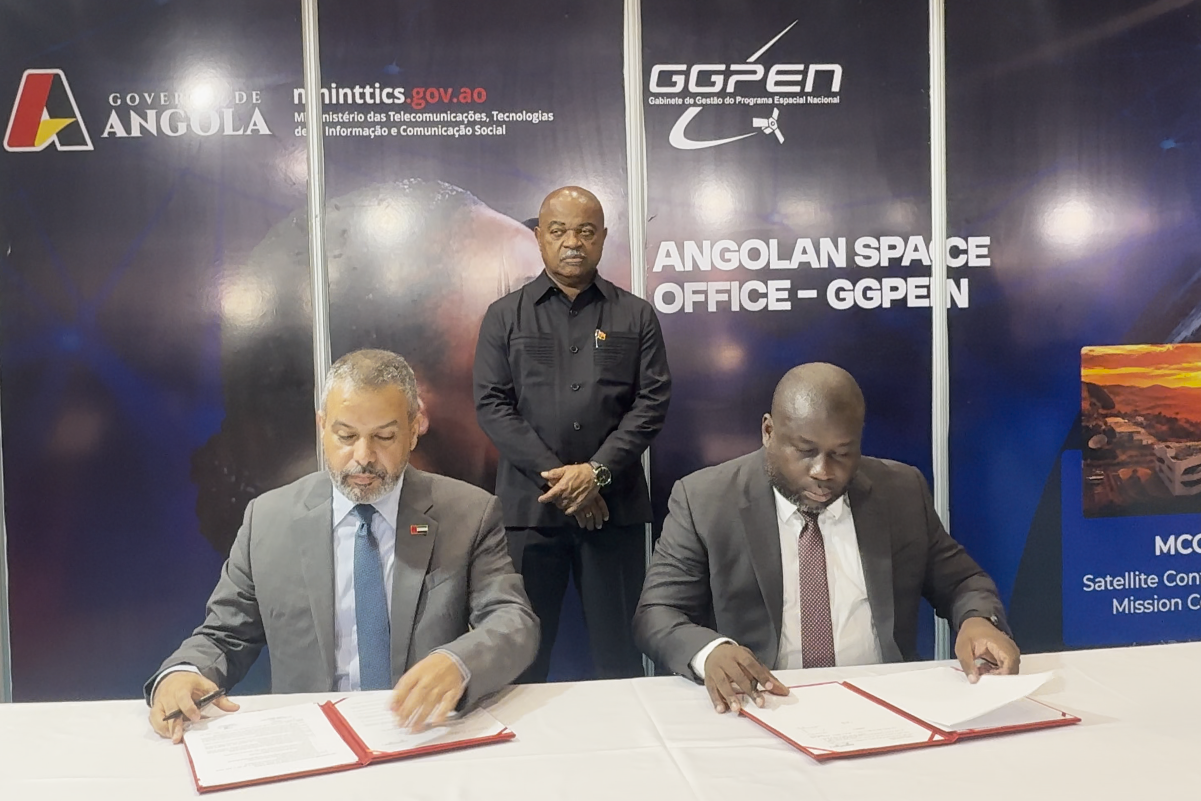
Angola and the United Arab Emirates have moved to deepen bilateral space cooperation through a new Letter of Intent (LoI) that sets out shared priorities in satellite data, Earth observation, and capacity building.
The agreement was signed by Dr Zolana Rui João, Director General of Angola’s National Space Program Management Office (GGPEN), and Eng. Salem Butti Salem Al Qubaisi, Director General of the UAE Space Agency, on September 25 in Abidjan, Côte d’Ivoire, on the sidelines of the Africa Space Expo (ASPEX) 2026, according to the GGPEN’s website.
It establishes an initial, non-binding framework for collaboration on the peaceful uses of outer space, with both sides seeking to expand joint work in space science, technology and applications.
Under the agreement, the two countries will explore cooperation in the exchange of satellite data and information, the development of Earth observation applications and services aligned with national and regional priorities, and collaboration on satellite development and related technologies.
The framework also covers joint research, innovation and technical initiatives, as well as the exchange of expertise and best practices on space policy, governance and regulation.
The parties may pursue training programs, workshops, technical exchanges, internships and other knowledge-sharing activities to strengthen skills in space science and applications. The text explicitly envisages the involvement of universities, research centers, government bodies and private-sector companies in future initiatives, subject to mutual agreement and applicable laws.
The document does not create legally binding obligations; specific projects will require separate agreements or arrangements between the parties. Even so, it adds to a growing portfolio of international partnerships for Angola’s space program, which has in recent months signed cooperation instruments with entities including the European Space Agency, SANSA and US startup Symphony Space, and launched initiatives such as Observa+ to deliver satellite-data applications for agriculture and climate-risk monitoring.