Central Africa's energy transition is usually described as a question of finance. Governments are seeking billions of dollars for new transmission lines, renewable energy projects, hydropower stations, and regional interconnections, while international development banks and private investors continue expanding their commitments across the region. Yet as investment grows, another constraint is becoming increasingly visible—one that money alone cannot solve.
The region's greatest constraint may no longer be technical expertise. It may be institutional capacity.
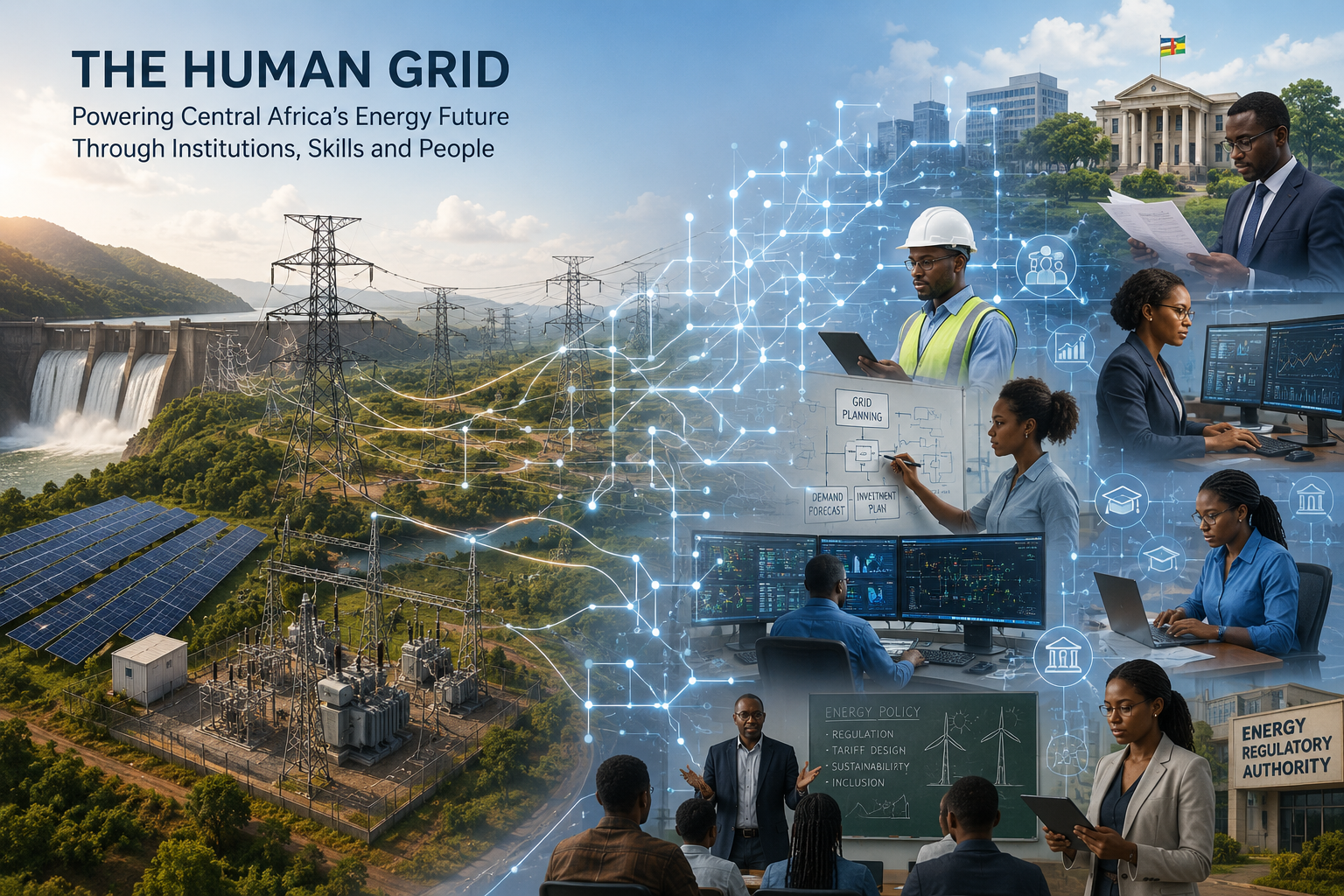
For years, discussions about workforce development have focused on engineers, electricians, solar technicians, and maintenance specialists. These professions remain indispensable, particularly as countries expand electricity generation and modernize aging power systems. But large energy projects depend on a much broader ecosystem of expertise that often receives far less attention.
Power plants require regulators capable of designing electricity markets, utilities able to manage increasingly complex grids, public institutions that can negotiate power purchase agreements, specialists who understand project finance, and policymakers able to translate long-term energy strategies into practical implementation. Without those institutions, infrastructure alone cannot deliver its full economic value. Recent assessments by organizations such as the International Renewable Energy Agency (IRENA) and AfriCGE increasingly point toward this deeper structural challenge. While technical training remains essential, they argue that strengthening public institutions has become equally important if countries hope to sustain large-scale investment in the energy sector.
That reality is increasingly being reflected in the design of new development programs. The SIRA program, backed by approximately $642 million, extends well beyond traditional technical training. Alongside developing engineering skills, it seeks to strengthen the capacity of regulators, utilities, government agencies, and energy planners responsible for managing increasingly sophisticated electricity systems. The objective is not simply to train more specialists, but to strengthen the institutions within which those specialists will ultimately work.
This distinction matters because the energy transition is ultimately an exercise in governance as much as engineering.
A modern solar park cannot function effectively if grid operators lack the capacity to integrate variable generation. Hydropower investments deliver limited long-term benefits if utilities cannot maintain transmission infrastructure or recover operational costs. International investors remain cautious when regulatory systems are unpredictable, licensing procedures are inconsistent, or public agencies lack the expertise to structure complex financing arrangements. Across Central Africa, governments are making important progress in expanding generation capacity and attracting international investment. Yet building energy infrastructure and building institutions are fundamentally different tasks. One can often be completed within a few years, while the other requires sustained investment in education, public administration, regulation, and professional development over decades.
The two, however, are inseparable.
As the region accelerates its transition toward more diversified and reliable energy systems, success will depend not only on the number of power plants commissioned or transmission lines constructed, but also on whether national institutions become capable of planning, regulating, financing, and operating those systems independently. The future of Central Africa's energy transition may ultimately depend less on the number of engineers it trains than on the strength of the institutions that allow those engineers to succeed.