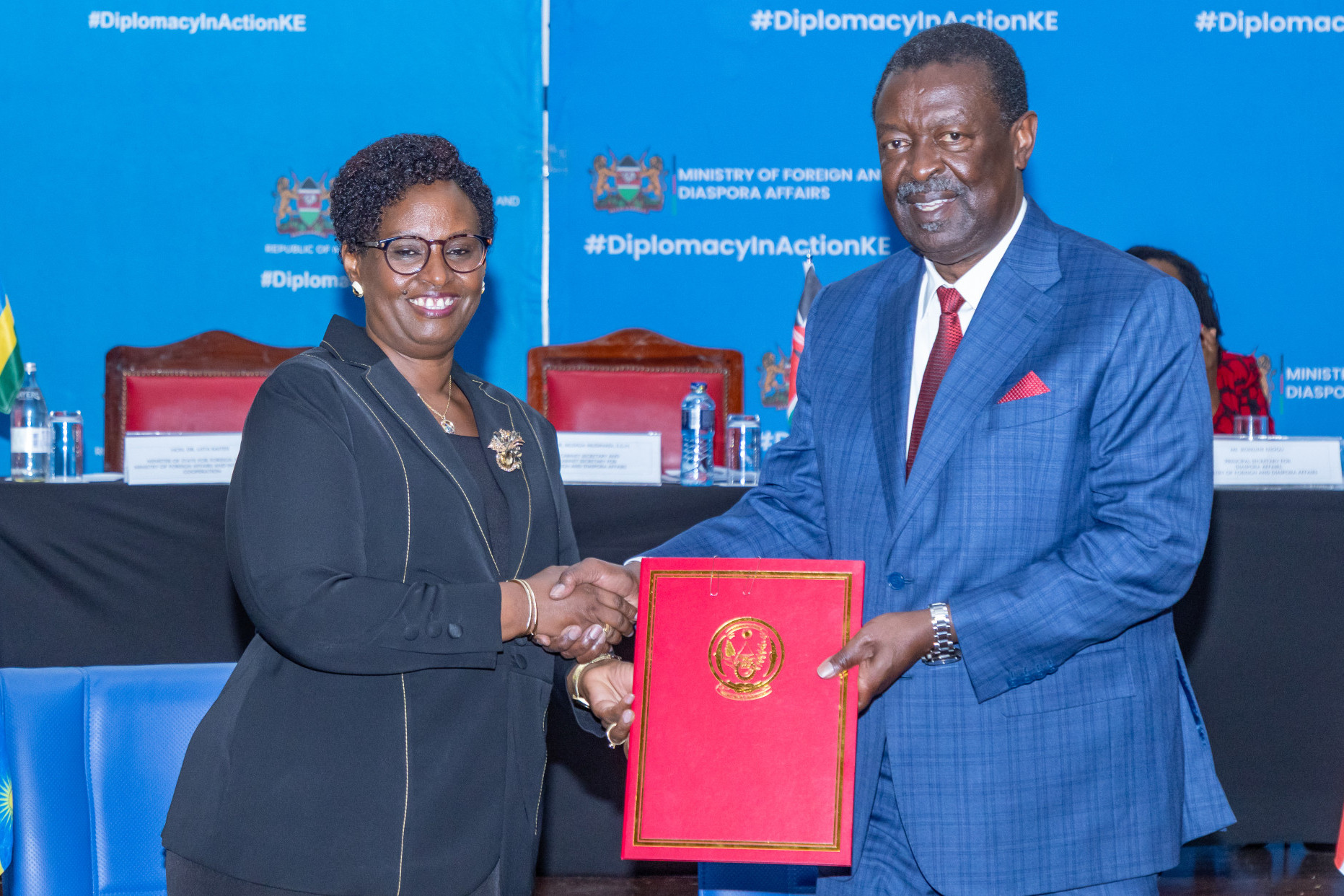
Rwanda and Kenya have signed 11 documents aimed at deepening cooperation across justice, security, immigration, governance, trade, infrastructure and energy.
Two formal agreements and nine memorandums of understanding were signed during the 10th Session of the Kenya-Rwanda Joint Permanent Commission for Cooperation (JPCC) in Nairobi on October 5-6, according to Kenya’s Ministry of Foreign and Diaspora Affairs.
The package includes agreements on mutual legal assistance in criminal matters and the transfer of sentenced persons, alongside MoUs covering political consultations, immigration, police cooperation, local governance, housing and urban development, diaspora management, water resources and irrigation, culture and heritage, and conservation.
Rwanda’s Minister of State for Foreign Affairs Usta Kaitesi described the JPCC as a mechanism to “review the status of our relations in various sectors, identify areas where progress can be accelerated, and explore new areas of cooperation.”
Kaitesi noted that Rwanda imported goods worth more than $398 million from Kenya in 2025, while exports to Kenya stood at $5.3 million, underscoring the scope to rebalance and grow two-way commerce.
Both governments pledged to facilitate the movement of goods and services, increase investment and strengthen business-to-business links, building on Kenya’s established presence in Rwanda’s services sector and Rwandan firms’ interest in the Kenyan market.
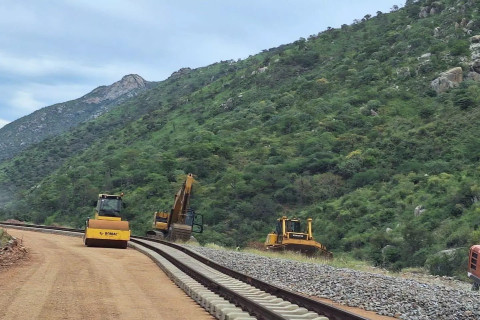
The JPCC reaffirmed the importance of the Northern Corridor linking Rwanda to the Port of Mombasa, shortly after the first 40,000-tonne bulk refined petroleum cargo for Rwanda arrived in Mombasa on September 29 under a June 29 framework that gives Kigali access to Kenya’s port, pipeline and storage infrastructure.
The shipment, carried by MT Sea Wolf for the Rwanda National Energy Company, is expected to help scale Rwanda-bound volumes through the corridor from tens of thousands to hundreds of thousands of cubic meters annually.
On the regional front, both sides agreed to coordinate within the East African Community, African Union, COMESA and the International Conference on the Great Lakes Region, while backing AfCFTA implementation and AU institutional reforms.