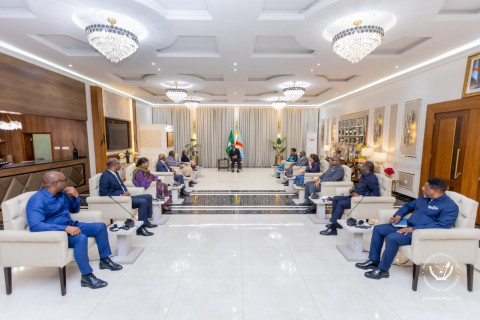
The Republic of the Congo is taking a more active diplomatic role in efforts to ease political tensions in the neighboring Democratic Republic of the Congo (DRC), as President Denis Sassou-Nguesso quietly encourages President Félix Tshisekedi to move forward with an inclusive national dialogue.
According to Africa Intelligence, Sassou-Nguesso has personally engaged with Tshisekedi in recent weeks, concerned that prolonged political instability in the DRC could spill across borders and undermine stability throughout Central Africa. His mediation reportedly intensified during the two leaders' meeting in Brazzaville earlier this month. The diplomatic effort comes as Kinshasa signals a willingness to open dialogue with opposition groups. President Tshisekedi recently agreed to launch a national political dialogue following consultations with leaders of the country's Catholic and Protestant churches, who have repeatedly called for broader political consensus amid growing domestic tensions. Religious leaders welcomed the decision, describing dialogue as an opportunity to reduce political polarization while addressing wider governance challenges alongside the ongoing security crisis in eastern DRC.
For Brazzaville, the initiative carries regional significance. The two Congos share one of Africa's closest political and economic relationships, with Kinshasa and Brazzaville located directly opposite each other on the Congo River. Any deterioration in security or political stability in the DRC has immediate implications for cross-border trade, migration and regional security cooperation. The mediation also reflects Sassou-Nguesso's longstanding preference for regional diplomacy. Over the years, the Congolese president has positioned himself as a mediator in several African crises, arguing that instability in neighboring states ultimately threatens the wider region. Although no formal mediation framework has been announced, the latest contacts suggest that the Republic of the Congo is seeking to play a more visible role in supporting political de-escalation in the DRC at a time when regional governments are increasingly concerned that prolonged instability could undermine security across Central Africa.