There is a province in eastern DRC right now where a deadly virus and a deadly insurgency are converging on the same towns, the same roads, and very possibly the same health workers trying to respond to both. That is not bad luck. It is what happens when state capacity collapses in one place long enough.
Ituri: Where Ebola Meets ISIS-Affiliated Violence
The Ebola outbreak has coincided with the Allied Democratic Forces — also known as the Islamic State Central Africa Province — carrying out its deadliest campaign targeting civilians in Ituri province since May 2022. ACLED recorded at least 149 civilian fatalities in Ituri last month alone, matching the total number of ADF-related civilian deaths in the province across the entire January-to-April period combined.
As the ADF shifts northward from neighboring North Kivu, Ituri has increasingly become both the epicenter of Islamist violence in the region and the center of the area's Ebola response — the same geography hosting two entirely different categories of crisis at once.
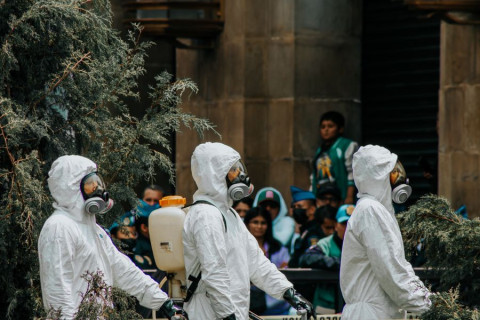
Think about what that actually means operationally. Health workers trying to trace Ebola contacts, set up isolation units, and run vaccination campaigns are doing so in a province where an ISIS-affiliated group is simultaneously carrying out its most lethal civilian campaign in four years. Disease surveillance requires access, trust, and the ability to move freely between villages. An active insurgency actively denies all three.
The Drones Are Getting More Sophisticated. So Is the War.
While Ituri burns, the broader conflict in eastern DRC is escalating in a different, more technologically advanced direction.
As of mid-June, the Congolese government has been building up troops in North and South Kivu, while the United States sanctioned senior commanders of both M23 and the FDLR operating in eastern DRC. Fighting has continued across multiple fronts — government-aligned forces clashing with M23-aligned militias in the South Kivu highlands, and M23 engaging Wazalendo fighters north of Bukavu in Kabare district.
Kinshasa has been actively modernizing its drone arsenal throughout the conflict — negotiating for additional Chinese combat drones in spring 2026 and adding Turkish Bayraktar drones to its arsenal by mid-2026. By April 2026, M23 was reportedly downing DRC's Chinese-made CH-4 drones and Turkish-made TB2 drones amid renewed escalation in the Kivu region.
This is no longer a conflict fought primarily with infantry and ambushes. It is increasingly a contest over which side has better drone technology and better counter-drone capability — an arms race playing out in a province that simultaneously cannot guarantee basic disease surveillance.
Switzerland, Again
Despite the battlefield escalation, the diplomatic track has not gone entirely quiet.
The Congolese government and M23 are expected to resume peace talks in Switzerland soon — continuing a negotiation process that has already cycled through Doha and Washington without producing a durable ceasefire. M23 and Rwanda have reportedly halted and reversed their military campaign in South Kivu since early 2026, a shift attributed partly to US policy, sanctions, and political pressure — even as fighting continues in other parts of the eastern provinces.
Tshisekedi's Constitutional Push Has a Security Justification Now Too
The referendum fight in Kinshasa — which we covered in detail this week — is increasingly being framed by its proponents not just as a political maneuver, but as a security necessity.
Proponents of constitutional revision argue it is necessary to stabilize and modernize the country. Tshisekedi and his allies have described the 2006 constitution as "outdated" and in need of being "adapted to Congolese realities," reflecting a view that the existing framework has limited the government's ability to respond to governance challenges, including security challenges in eastern DRC. Critics note that these proponents have not clarified any specific mechanisms beyond centralized rule and appeals to "popular sovereignty" that would actually achieve these stated goals.
In other words: the same eastern security crisis converging with the Ebola outbreak in Ituri is now being cited in Kinshasa as a reason the president needs expanded constitutional authority — without a clear explanation of how expanded authority would actually fix a province where the problem is presence, not paperwork.
CAR: A Mission Winding Down at a Delicate Moment
While DRC's eastern crisis deepens, neighboring CAR's UN mission is attempting a careful drawdown, even as the underlying security picture remains fragile.
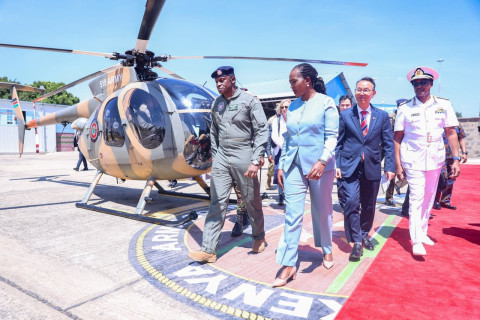
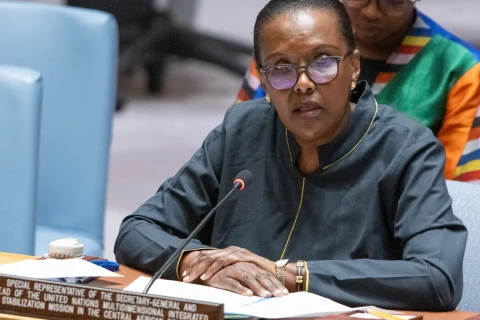
Following the conclusion of CAR's national electoral processes, MINUSCA is conducting a reconfiguration intended to evolve gradually toward a phase of supporting Central African authorities in consolidating gains made in security, peace, access, and state authority. Special Representative Valentine Rugwabiza had earlier described CAR as having entered "a decisive phase in terms of consolidation, confidence and national cohesion." Decisive phases, in this region, have a way of not staying decisive for long.
The Pattern That Connects Ituri to Kinshasa to Bangui
The African Union's Peace and Security Council posed an uncomfortable question in its June 2026 review of structural vulnerability across the continent: why does Africa continue to respond late — at enormous human, political, and financial cost — to crises whose structural preconditions were identifiable years, sometimes decades, before violence erupted?
Ituri did not become a province where an epidemic and an insurgency converge by accident. Eastern DRC did not become a drone arms race by accident. Kinshasa did not arrive at a constitutional crisis dressed up as a security solution by accident. Each of these was, by the AU's own diagnosis, visible coming for years. The region keeps responding to the fire after it has already spread to the next building.