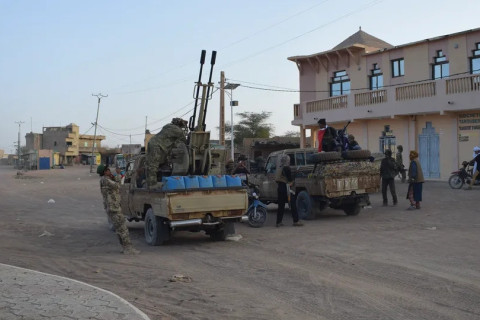
For years, the wars raging across the Sahel were largely viewed as West Africa's security problem. Today, that assumption is becoming increasingly outdated. Stretching from Mali and Burkina Faso to Niger and Chad, the Sahel has evolved into one of the world's most contested resource frontiers. Gold, uranium, oil and other strategic minerals have transformed the region into a battleground where governments, military juntas, jihadist organisations, foreign powers and multinational corporations all pursue competing interests. The consequences are no longer confined to the Sahel itself. They are increasingly spilling southward into Central Africa.
The economic stakes are enormous.
Niger alone holds around 5% of the world's known uranium reserves, making it one of the most strategically important suppliers of nuclear fuel. For decades, uranium from the Arlit mining district supported Europe's civilian nuclear industry. At the same time, Niger has expanded its role as an oil producer through the Niger–Benin Export Pipeline, developed by the China National Petroleum Corporation (CNPC), opening another strategic energy corridor to international markets. To the west, Mali and Burkina Faso have become two of Africa's largest gold producers. Gold exports generate billions of dollars annually, but vast artisanal mining areas have also become important sources of financing for armed groups operating beyond state control. Rather than simply attacking military positions, insurgent organisations increasingly seek influence over territories where mining activity generates continuous cash flows. These conflicts are often portrayed primarily as ideological struggles against extremist organisations. In reality, the economics of war have become just as important as its politics. Control over strategic resources provides access to taxation, smuggling networks, recruitment opportunities and logistical corridors. The longer instability persists, the more profitable these parallel economies become for armed actors.
This is precisely why Central Africa can no longer afford to view the Sahel as someone else's problem. Chad has emerged as the critical bridge between the two regions. Geographically positioned between the Sahel and Central Africa, it functions as both a buffer and a transit corridor. Weapons, armed groups and displaced populations increasingly move through Chad toward neighbouring countries, placing additional pressure on already fragile security systems.
The implications extend well beyond military affairs.
For Cameroon, instability along northern transport corridors increases security costs while complicating regional trade and logistics. For the Central African Republic, where state authority remains limited outside major urban centres, additional cross-border pressure further complicates efforts to stabilise remote regions. Even countries geographically removed from the Sahel, including the Republic of the Congo and Gabon, are not insulated from the consequences. Rising regional insecurity increases investor risk perceptions, raises insurance costs and complicates financing for large-scale infrastructure and energy projects.
The pattern is becoming increasingly clear. Across the Sahel, strategic resources are concentrated in countries whose instability now has direct implications for Central Africa:
Niger – Uranium and Oil: Home to roughly 5% of the world's known uranium reserves, Niger has long been a strategic supplier of nuclear fuel while emerging as a growing oil exporter through the Niger–Benin Export Pipeline. Any prolonged instability threatens both energy exports and regional transport corridors.
Mali – Gold: One of Africa's leading gold producers, Mali generates billions of dollars in mineral exports each year. At the same time, gold-rich regions have become an important source of revenue for armed groups operating outside government control.
Burkina Faso – Gold: The rapid expansion of artisanal mining has coincided with worsening insecurity, creating an environment where illegal taxation, smuggling and armed violence increasingly overlap.
Chad – Oil and Strategic Geography: While Chad remains an important oil producer, its greatest strategic value lies in its location. Acting as the gateway between the Sahel and Central Africa, the country has become a critical transit corridor through which instability can spread southward.
The result is a regional security environment in which economic assets have become inseparable from military calculations. Pipelines, mining concessions, export corridors and transport infrastructure are no longer simply development projects. They have become strategic assets whose control influences both national budgets and battlefield dynamics. This is why governments across Central Africa should pay close attention to developments north of their borders. The conflicts unfolding across the Sahel are not simply spreading geographically. They are gradually reshaping investment decisions, security priorities and regional diplomacy throughout Central Africa. As long as strategic resources continue to finance competing armed and political interests, the boundary between the Sahel and Central Africa will become increasingly difficult to distinguish.
The region's next security challenge may not begin within Central Africa at all. It may simply arrive there.