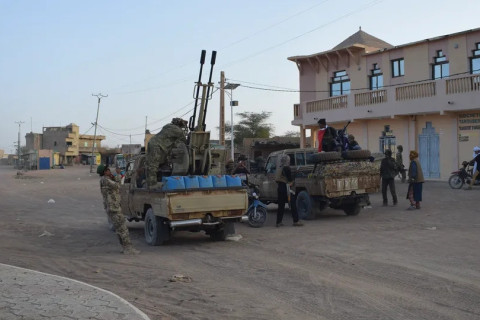
On July 14, the UN Security Council committee overseeing the arms embargo on the Democratic Republic of the Congo added six individuals and two armed groups to its sanctions list. Two days later, Congolese army officers were in Goma—the city controlled by one of those sanctioned groups—for a ceasefire monitoring meeting under the Doha peace process. During the same week, delegations from the DRC, Rwanda, and international observers convened for the fifth Joint Security Coordination Mechanism meeting established under the Washington Accords. Far from being contradictory, these parallel developments illustrate how the conflict in eastern Congo is increasingly being managed through simultaneous diplomatic and coercive tracks, each pursuing the same objective through different means.
The gap between those two tracks has become increasingly revealing. Sanctions seek to isolate and pressure the armed actors driving the conflict, while diplomacy attempts to draw governments and military representatives into negotiations. Together they offer a clearer picture of the conflict than either approach does in isolation, highlighting both the determination of the international community to sustain pressure and the limits of that pressure in changing realities on the ground.
Who Was Sanctioned—and Why It Matters
The composition of the sanctions list provides a snapshot of the armed landscape in eastern Congo. Corneille Nangaa, leader of the Alliance Fleuve Congo (AFC)—the political umbrella that includes M23—was designated alongside the AFC itself. John Imani Nzenze, M23's chief of intelligence, was also sanctioned individually.
The measures extended well beyond M23. The Security Council designated Sébastien Uwimbabazi and Gustave Kubwayo of the Democratic Forces for the Liberation of Rwanda (FDLR), the Rwandan Hutu armed group with roots in the 1994 genocide that UN experts have described as fighting alongside, rather than as part of, the Congolese military against M23. Charles Sematama, a commander of the Twirwaneho armed group operating in South Kivu's Hauts Plateaux, was also listed together with Twirwaneho as an entity, while another designation targeted a logistics commander linked to the Allied Democratic Forces. The composition of the list is significant because it extends far beyond a simple distinction between government forces and rebels. By targeting leaders associated with M23, the FDLR, Twirwaneho, and the Allied Democratic Forces, the Security Council is treating eastern Congo not as a two-sided conflict but as a fragmented security environment in which multiple armed actors have independently engaged in conduct warranting sanctions. The measures themselves—asset freezes, travel bans, and the continuation of the arms embargo—are familiar tools. The broader message lies in who has been designated.
Washington Moved First
The UN measures did not emerge in isolation. In early June, the U.S. Treasury's Office of Foreign Assets Control (OFAC) had already imposed sanctions on Gustave Kubwayo and John Imani Nzenze, explicitly linking those measures to the December 2025 Washington Accords for Peace and Prosperity. The Treasury argued that both the Democratic Republic of the Congo and Rwanda carry obligations under the agreement—the DRC to neutralize the FDLR, and Rwanda to withdraw its forces and end support for M23—and that sanctions were intended to reinforce pressure on both sides simultaneously. The subsequent UN designations, covering some of the same individuals while expanding the list to additional actors, suggest a coordinated sequence of international pressure rather than two institutions acting independently. The pattern also reflects the extent to which diplomatic momentum surrounding eastern Congo has increasingly been shaped by Washington's framework before being reinforced through multilateral mechanisms.
What Sanctions Can—and Cannot—Do
The practical impact of asset freezes or travel bans on militia commanders operating in remote areas of eastern Congo is limited. Their principal value lies elsewhere: they establish political accountability, clarify the international community's assessment of responsibility, and create a legal and diplomatic record that may influence future negotiations or judicial proceedings.
Their limitations become clearer when compared with developments on the ground. During the same week the sanctions were announced, reporting from Critical Threats indicated that clashes between M23-aligned Twirwaneho fighters and pro-government forces continued in South Kivu's Hauts Plateaux, even as ceasefire monitoring under the Doha process and security coordination meetings under the Washington framework were taking place. Sanctions, diplomacy, and military engagement are unfolding simultaneously, yet none has succeeded in bringing sustained fighting to an end.
Managing Rather Than Resolving the Conflict
The latest round of sanctions illustrates the broader architecture of international engagement in eastern Congo: multiple institutions applying incremental pressure through different channels because no single mechanism has proved sufficient on its own. Neither sanctions, nor the Doha negotiations, nor the Washington Accords' broader security and economic framework has yet fundamentally altered the dynamics of the conflict. The Security Council's decision in June to extend the DRC sanctions regime through July 2027 reflects an expectation that sustained international pressure will remain necessary for the foreseeable future.
For a peace process built in part on the premise that economic incentives—including increased investment and regional mineral value chains—could gradually make cooperation more attractive than continued conflict, the ongoing need to sanction commanders across multiple armed groups suggests those incentives have yet to reach the actors directing military operations. Fighting in the Hauts Plateaux has continued despite sanctions, ceasefire monitoring mechanisms, and ongoing diplomatic engagement. For now, the calculations of those leading the conflict appear to remain driven more by territorial control than by the economic incentives underpinning the Washington Accords.