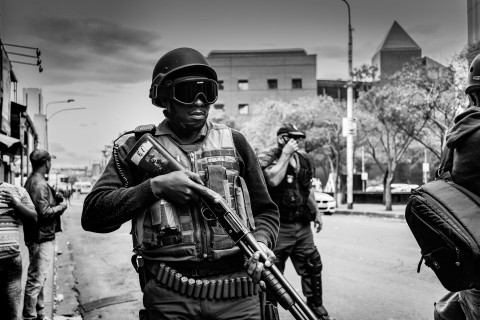
For decades, security in Central Africa was largely viewed as a government responsibility. Armies defended borders, police protected cities, and international peacekeepers filled gaps where national institutions struggled. Businesses operating in the region certainly considered security risks, but protection itself was rarely seen as a major component of economic development.
That assumption is quietly changing.
Today, security has become far more than a public function. It is increasingly a business service, an investment requirement, and an expanding economic sector in its own right. Across Central Africa, governments, multinational corporations, logistics operators, mining companies, energy developers, and financial institutions are spending growing amounts not simply to build infrastructure, but to protect it.
The shift reflects the changing nature of investment itself.
Large infrastructure projects now rarely consist only of roads, ports, railways, power plants, or industrial facilities. Modern investment packages routinely include surveillance systems, access-control technologies, cybersecurity, perimeter protection, satellite monitoring, emergency response planning, and specialized risk management. Security is no longer treated as an afterthought. It is designed into projects from the very beginning. This evolution is particularly visible in sectors that underpin Central Africa's economic transformation. Mining operations require secure transport corridors linking remote extraction sites with export terminals. Energy infrastructure demands continuous protection for substations, transmission networks, and control centers. Ports and logistics hubs increasingly rely on sophisticated digital monitoring systems that safeguard both physical assets and commercial data. As infrastructure becomes more technologically advanced, so too does the security ecosystem surrounding it.
The private sector has responded accordingly. Companies specializing in risk assessment, digital surveillance, cybersecurity, drone monitoring, logistics security, and infrastructure protection are becoming increasingly important participants in major investment projects. For many investors, security planning now represents a standard component of project financing rather than an exceptional contingency. Insurance markets reinforce this trend. Political risk insurance, cargo protection, business interruption coverage, and infrastructure risk assessments increasingly influence financing decisions long before construction begins. Investors evaluate not only whether a project can generate revenue, but also whether its operating environment can remain sufficiently stable over decades. In this sense, security has become an economic variable rather than merely a political one.
Technology is accelerating that transformation. Artificial intelligence supports video analytics at ports and industrial facilities. Satellite imagery helps monitor transport corridors and remote infrastructure. Drone surveillance increasingly complements traditional patrols across large mining concessions and energy projects. Cybersecurity has become indispensable as utilities, ports, and financial institutions digitize operations. The security sector itself is becoming more knowledge-intensive, creating demand for highly skilled professionals alongside traditional protective services. This growing industry also reflects a broader reality. As regional economies become more interconnected through infrastructure corridors, energy networks, and digital services, vulnerabilities become increasingly interconnected as well. A disruption affecting a railway, electricity network, or port can quickly cascade across supply chains, increasing the economic value of resilience itself.
None of this suggests that governments are retreating from their responsibility to provide public security. Rather, it illustrates how economic development increasingly depends on complementary layers of protection delivered by both public institutions and private expertise. Modern infrastructure requires modern security, and investors increasingly expect both to evolve together. Central Africa's economic future will still be shaped by natural resources, infrastructure investment, and industrial diversification. Yet another sector is quietly becoming essential to that transformation. Security is no longer simply what protects economic growth. Increasingly, it has become part of the economy itself.