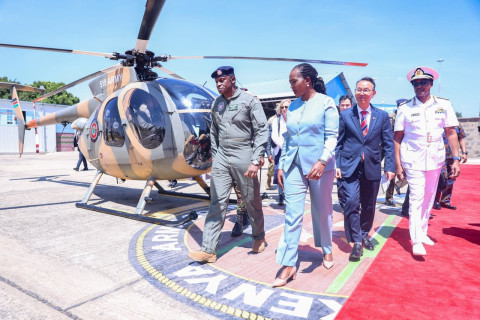
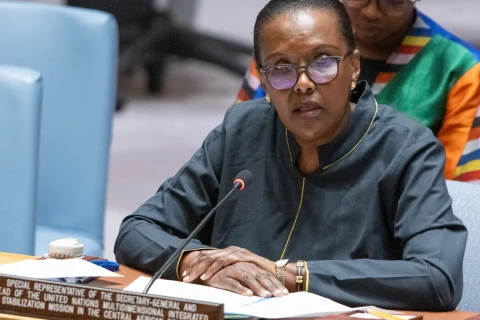
In late July, the Democratic Republic of the Congo's foreign minister traveled to Jerusalem and signed two memoranda of understanding with Israel—one establishing regular political consultations between the two governments, the other creating cooperation between their diplomatic academies. Modest on paper, the agreements nevertheless represent the most institutional step yet in a partnership that has been quietly rebuilding since Israeli President Isaac Herzog's state visit to Kinshasa in November 2025. That visit included more than an hour of private talks with President Félix Tshisekedi and produced a joint commitment to strengthen bilateral ties that, until recently, had barely figured among either government's diplomatic priorities. The timing is significant. Kinshasa is not simply adding another international partner. It is extending a foreign-policy strategy that has become increasingly visible throughout the past year: cultivating parallel relationships with multiple external powers. The United States through the FORGE minerals framework, China through a renegotiated Sicomines agreement, Qatar via mediation with M23, and now Israel all represent different pillars of the same approach. For a resource-rich country facing persistent security challenges, competition among external partners has become one of its strongest sources of diplomatic leverage.
What Israel Brings
Security remains the centerpiece of the renewed partnership. Following his meeting with Herzog, President Tshisekedi specifically identified Israeli expertise in defence and security while also pointing to agriculture, infrastructure, and advanced technology as areas for deeper cooperation. He simultaneously encouraged Israeli companies to explore opportunities in mining, infrastructure, and energy. Those discussions built on an earlier meeting between Tshisekedi and Prime Minister Benjamin Netanyahu during the 2025 UN General Assembly. There, both leaders explored cooperation in security, trade, cyber technologies, and agriculture. Netanyahu also invited Tshisekedi to visit Israel—an invitation that, if accepted, would mark the first visit by a Congolese head of state since 1982.
Security cooperation itself is not new.
Israel previously trained Congolese special forces involved in operations against the Allied Democratic Forces (ADF), while the Congolese military has publicly displayed Israeli-made EMTAN MZ-4P assault rifles during military parades in Kinshasa. That cooperation was interrupted in 2023, when Israel withdrew its military trainers following the outbreak of the Israel–Hamas war. The pause demonstrated how conflicts far outside Central Africa can reshape bilateral defence cooperation. The latest agreements suggest both governments have now decided to rebuild those ties on a more durable institutional basis rather than relying on personal relationships or ad hoc arrangements.
One Partner Among Many
Israel's importance becomes clearer when viewed within the DRC's much broader defence network. Current procurement patterns show that FARDC sources military equipment and training from an unusually diverse group of partners, including the United States, Russia, China, France, the United Kingdom etc.
At the same time, Kinshasa has been expanding defence discussions with the Czech Republic covering pilot training, Air Force cooperation, and broader military modernization—developments that have unfolded alongside the rapprochement with Israel. No single supplier dominates this landscape, and that appears entirely intentional. A military drawing equipment, training, and expertise from nearly twenty different countries is far less vulnerable to the political conditions, sanctions, or strategic priorities of any one partner. It mirrors the approach we have previously documented in Congo's mining sector, where Gécamines balances Western and Chinese investors to improve its negotiating position. Applied to defence, the same logic produces a security policy built on diversification rather than dependence.
A Complicated History
The renewed partnership also carries historical sensitivities. In 2019, investigations revealed that Israeli private intelligence firm Black Cube had been hired by then-President Joseph Kabila to monitor political opponents in an operation widely referred to as "Operation Coltan." The episode raised uncomfortable questions about private intelligence activities and commercial interests surrounding the DRC's strategic mineral sector. Today's relationship looks markedly different. Rather than relying on opaque private arrangements, both governments are formalizing cooperation through official diplomatic agreements and government institutions, giving the partnership greater transparency and political legitimacy.
Trade, however, still lags well behind diplomacy.
According to International Trade Centre data cited by Ecofin Agency, bilateral trade reached only US$6.7 million in 2025. That disparity is revealing. Political dialogue and security cooperation are advancing well ahead of commercial ties, suggesting that the partnership is currently being built from the top down through government engagement rather than private-sector momentum.
Diversification as Strategy
For Kinshasa, expanding ties with Israel is less about choosing a new strategic ally than about reinforcing a broader foreign-policy doctrine. The DRC continues to manage conflict in the east, implement a fragile US-backed peace framework, and renegotiate relationships with competing international investors in its critical minerals sector. Under those circumstances, broadening the country's diplomatic and security network is both a hedge against uncertainty and a source of negotiating leverage.
The objective is not to replace one partner with another. It is to ensure that no single partner becomes indispensable. As competition for influence in the DRC continues to intensify, diversification itself has become one of Kinshasa's most valuable strategic assets.