Although the Islamic State's physical caliphate across the Middle East was systematically dismantled, the core organization has adapted by decentralizing its command structure and empowering highly lethal regional branches across Sub-Saharan Africa.
In Central Africa, the consequences are most visible in eastern Democratic Republic of Congo (DRC), where Islamic State-linked Allied Democratic Forces (ADF) and Islamic State Central Africa Province (ISCAP) have intensified attacks. Meanwhile, Boko Haram and Islamic State West Africa Province (ISWAP) continue to threaten communities around Lake Chad, especially in Cameroon and Chad.
The Islamic State Sahel Province (ISSP), formerly known as the Islamic State in the Greater Sahara (ISGS), has consolidated its position as one of the most expansionist jihadist organizations in West Africa, operating primarily across the volatile Liptako-Gourma region (the tri-border zone connecting Mali, Niger, and Burkina Faso).
By exploiting political instability, military coups, porous borders, and local socioeconomic grievances, these African affiliates generate their own revenue, recruit local populations, and execute sophisticated insurgencies. As a result, while the Islamic State no longer governs vast swathes of the Middle East, its African provinces ensure that its global ideological and operational momentum remains fully intact.
The Global Terrorism Index 2026 said Islamic State remained the world’s deadliest terrorist organization in 2025, even as its activity became concentrated in fewer countries. The report said attacks attributed to Islamic State in sub-Saharan Africa almost doubled during the year, while activity declined in the Middle East and North Africa. Six of the 10 countries most affected by terrorism were in sub-Saharan Africa, and the Democratic Republic of Congo recorded its worst position on the index.
Meanwhile, Islamic State’s branches operate as a looser network, with local commanders often responding to regional conditions rather than following a single, visible central leadership. But the model has allowed the group to survive through affiliates that exploit weak governance, porous borders, remote terrain and unresolved local grievances.
For Central African governments, the challenge goes beyond defeating individual armed groups. Military operations must be combined with intelligence-sharing, protection for rural populations, humanitarian access and basic public services.
Congo’s expanding front
The most severe Central African consequences are unfolding in Ituri and North Kivu provinces of the DRC. In August, at least five farmers were killed and about 50 people abducted during a raid on Kilibo village in Mambasa territory.
The raid followed a series of deadly incursions across Mambasa. From May to August 2026, 48 ADF attacks had killed at least 307 civilians and left 103 people missing; 216 homes were destroyed and more than 10,000 families displaced towards Mambasa, Nia-Nia, Biakato and neighboring Irumu territory.
The violence is damaging the area’s fragile economy. Farming, mining and local trade have been disrupted, while schools and health facilities have suspended operations in some communities. Thirteen people were killed in an August 7 attack on Banana-Ecole village, where shops, homes, vehicles and motorbikes were burned.
The ADF originated in Uganda before establishing bases in eastern Congo and pledging allegiance to Islamic State. Islamic State refers to its Congolese network as Islamic State Central Africa Province, or ISCAP. The group continues to target both civilians and security forces. Its activity has also appeared in Haut-Uele province, suggesting either operational expansion or a shift away from areas under military pressure.
In a March briefing, MONUSCO (UN Organization Stabilization Mission in the DRC) said that rebel attacks were causing deaths, displacement and infrastructure damage, while noting that ADF attacks had resumed in Mambasa, away from some of the group’s traditional operating areas. The wider country faces 6.4 million internally displaced people and severe humanitarian funding shortages.
Lake Chad pressure
ISWAP and the original Boko Haram faction (Jamā'at Ahl as-Sunnah lid-Da'wah wa'l-Jihād or JAS) have turned the Lake Chad Basin into one of the world's most durable conflict zones. Operating across the converging borders of Nigeria, Niger, Chad, and Cameroon, both groups leverage geographic terrain, porous borders, and acute governance deficits to sustain their insurgencies.
The complex topography of the Lake Chad Basin makes regular military patrols nearly impossible and allows insurgents to set up hidden logistics bases on islands unreachable by heavy armored vehicles. When national militaries launch operations, fighters routinely retreat across international borders, moving between Borno State (Nigeria), Diffa (Niger), Lac Region (Chad), and Far North (Cameroon) to evade capture.
ISWAP in particular has moved beyond pure violence to act as a pseudo-state. In areas where state authorities are absent, ISWAP provides basic justice systems, regulates local markets, digs wells, and offers health services to gain local compliance. As an official affiliate of the core Islamic State, ISWAP generally targets military outposts, government assets, and international aid workers while seeking to maintain functional relationships with local Muslim populations.
Boko Haram, historically led by Abubakar Shekau, employs indiscriminate violence, including suicide bombings against civilian markets, mass kidnappings, and village raids. Following Shekau’s death in 2021, ISWAP attempted to absorb Boko Haram. However, remaining Boko Haram loyalists retreated into the Sambisa Forest and Mandara Mountains, triggering a brutal ongoing civil war between the two groups for control over trade routes and territory.
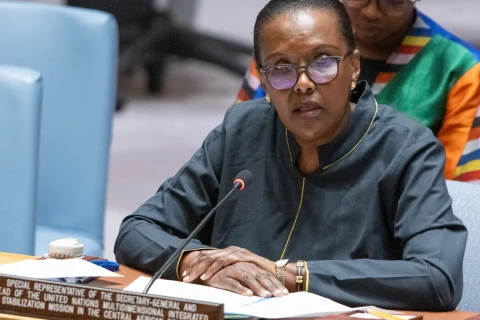
In June, UN Assistant Secretary-General Martha Pobee told the Security Council that civilians in Cameroon and Chad continued to suffer attacks and human-rights abuses by Boko Haram-affiliated groups. She said the militants were exploiting gaps in state authority and described the Multinational Joint Task Force as essential to the regional response.
The security burden on Chad is compounded by the war in neighboring Sudan. The UN said more than 900,000 Sudanese refugees and 300,000 Chadian returnees had entered the country since April 2023, placing pressure on resources and social cohesion in eastern provinces. In northern Cameroon, meanwhile, attacks continue to affect farmers, traders and communities around the lake.
The Central African Republic remains exposed to cross-border armed activity along its eastern and northern frontiers, including instability linked to Sudan and South Sudan. A UN Security Council assessment said insecurity persisted in Vakaga and Haut-Mbomou, while armed groups and cross-border incursions continued to threaten civilians.