For the past three years, the government of President Faustin-Archange Touadéra in Bangui maintained a fragile, highly managed narrative of stabilization. Backed by heavy security guarantees from Russian paramilitaries and the strategic positioning of UN peacekeepers (MINUSCA), the Central African Republic (CAR) appeared to have successfully contained the major armed rebel coalitions that nearly overthrew the state in 2021.
But as of June 2026, that domestic stability has been violently compromised from the outside. The brutal civil war in neighboring Sudan has leaked directly across the porous northeastern frontier, triggering a rapid, toxic remilitarization of the CAR’s volatile northern prefeclures—most notably Vakaga and Haute-Kotto.
The conflict has done what years of domestic political negotiations could not: it has split, re-armed, and radicalized the remnants of the ex-Séléka rebel factions, pulling them into a bloody proxy war that threatens to ignite a brand-new cycle of sectarian violence within the CAR itself.
The Splitting of the Ex-Séléka: A Proxy Contagion
The core of the current crisis lies in the complete fragmentation of the Popular Front for the Renaissance of the Central African Republic (FPRC) and the Patriotic Movement for Central Africa (MPC)—the dominant, Muslim-majority rebel groups that have controlled the northern hinterlands for over a decade.
According to the latest intelligence briefings submitted to the UN Security Council on June 11, 2026, the War in Sudan has turned these factions into mercenary pools for both belligerents in Khartoum.
-
The Pro-SAF Vector: Elite fighters from the FPRC under decentralized northern commanders crossed into Darfur in late 2025 to fight alongside the Sudanese Armed Forces (SAF). In return, they have been paid in high-grade weaponry, anti-aircraft systems, and advanced communications gear. By June 2026, these combat-hardened units have begun filtering back into northern CAR, bringing heavy, state-level military hardware into regions where the central government has zero physical presence.
-
The Pro-RSF Corridor: Conversely, rival elements within the MPC have embedded themselves within Mohamed Hamdan Dagalo’s Rapid Support Forces (RSF). They have turned the border town of Am Dafok into a massive, lucrative logistics funnel, moving stolen vehicles, fuel, and gray-market ammunition from the CAR’s northern forests straight into the hands of RSF units besieging El Fasher.
This isn't just an external mercenary trade; it is a domestic time bomb. Factions that previously operated under a loose anti-government alliance within the CAR are now actively killing each other on Sudanese soil—and they are bringing those blood feuds back across the border into the CAR.
The Battle for Birao: Sovereignty in Freefall
The strategic flashpoint for this crisis is Birao, the capital of the Vakaga prefecture. Positioned at the literal crossroads of the CAR, Chad, and Sudan, the town is currently experiencing a massive influx of heavy weaponry that has completely overwhelmed local stabilization efforts.
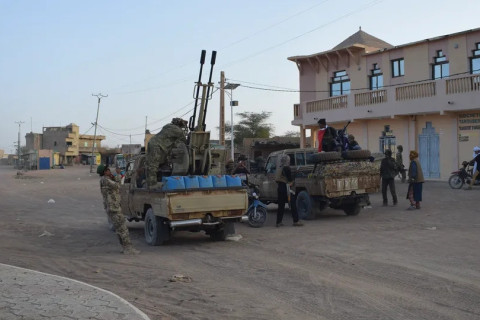
On May 28, 2026, a heavily armed convoy of returning FPRC fighters clashed directly with a mixed detachment of the Central African Armed Forces (FACA) outside Birao. The regular army units, despite their modern equipment, were forced to make a tactical retreat after encountering sophisticated anti-tank guided missiles (ATGMs) that entered the rebel inventory via Sudanese black markets.
The security architecture of the north is in freefall. While MINUSCA forces remain confined to heavily fortified bases in Birao, the surrounding bush is entirely regulated by shifting, heavily armed rebel checkpoints. The state's monopoly on violence in the north has not just been challenged; it has been effectively erased.
The Economic Fuel: The Am Dafok Smuggling Matrix
The structural longevity of this northern remilitarization is bankrolled by total control over the region's raw resource economy. The border zone between the CAR and South Darfur contains some of the richest unmapped artisanal gold deposits on the continent.
With the RSF controlling the Sudanese side of the border and the ex-Séléka managing the CAR side, the Am Dafok smuggling matrix has become completely autonomous. Gold mined in the Vakaga prefecture is moved across the border to fund the purchase of heavy weaponry and consumer drone fleets, which are then used to protect the very same mines from government incursions.
Bangui’s official decree closing the northern borders has had zero economic impact. The volume of untracked bullion and heavy weapons moving through the Am Dafok corridor has reached its highest level since the outbreak of the Sudanese civil war, creating a completely self-sustaining war economy.