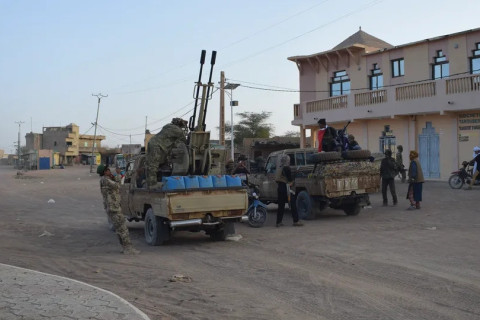
For the past several years, global security assessments of Central Africa frequently emphasized Moscow’s asymmetric power projection. By deploying lean, low-cost military security packages, tactical advisers, and private security architecture across fractured states like the Central African Republic (CAR) and parts of the Sahel, Russia successfully carved out a high-profile geopolitical footprint at a minimal financial cost.
However, mid-2026 data reveals that the protracted war in Ukraine has triggered a sharp systemic correction. As Moscow remains locked in a high-intensity, resource-draining European conflict, its capacity to sustain, scale, or financially anchor its African ambitions has hit a structural wall.
This strategic distraction has left a profound security and economic vacuum in the heart of the continent. Rather than triggering a local power vacuum, this space is being aggressively contested by two heavyweights playing a completely different game: China, which is transforming its extraction dominance into an absolute infrastructure monopoly, and Western Europe, which is structurally overhaulings its diplomacy through the lens of supply-chain defense.
Beijing shifts focus: It’s no longer about finding minerals, it’s about moving them
While Western intelligence focused heavily on the shifting names of Russian paramilitary configurations in Africa, China quietly executed a profound tactical evolution. Having already secured control over roughly 70% of the Democratic Republic of the Congo’s (DRC) copper and cobalt extraction nodes, Beijing’s state-owned enterprises (SOEs) have shifted their focus from upstream mining to midstream infrastructural lock-in.
The rationale is clear: controlling the ore in the ground is meaningless if you do not control the rails, grids, and ports required to move it.
To anchor its supply lines against sudden Western maneuvers, Beijing committed over $1.4 billion earlier this year to fast-track the rehabilitation of the TAZARA Railway, a trans-regional line running opposite to Western-backed routes, linking the Zambian Copperbelt straight to the Indian Ocean port of Dar es Salaam in Tanzania. Simultaneously, Chinese capital is underwriting domestic smelting and battery-grade refining hubs right inside the DRC, ensuring that local resources remain structurally integrated into Asian tech ecosystems long before they ever reach a seaport.
Western Europe’s Structural Re-Assembly
Concurrently, Brussels and key European capitals—most notably Paris and Berlin—have recognized that traditional, lecture-heavy "humanitarian diplomacy" has effectively run its course. Realizing they can no longer match China’s raw state-backed capital or rely on heavy, old-footprint military interventions, Western European strategists are pivoting toward targeted, hyper-pragmatic geo-economic containment.
The frontline of this European push is the Global Gateway initiative, which serves as the financial backbone for the revitalization of the Lobito Corridor.
By laying high-capacity rail lines from Angolan deep-water ports directly into the heart of the Congolese mining sectors, Europe is attempting to build a secure, Western-facing siphon for the minerals required to power its domestic EV and defense industries. Instead of sprawling military bases, Western Europe is returning via specialized engineering packages, cross-border digital customs automation, and tailored green-energy transmission grids designed to make Western industrial partnerships structurally cleaner and faster than their Eastern counterparts.
The ongoing attritional war in Eastern Europe has fundamentally exposed the limits of pure, security-first power projection. Moscow’s military-centric model in Africa, while effective for short-term regime survival, lacked the vast capital reserves required to anchor long-term economic architectures.
As a result, the real map of international security in Central Africa is no longer being drawn by tactical deployments or security details, but by the laying of heavy rail gauges, the acquisition of ports, and the secure routing of the commodities that will define the geopolitical hierarchy for the next fifty years. Beijing has successfully dug in across the continent's eastern outlets, but Western Europe's rapid mobilization along the Atlantic axis ensures that the battle for Africa’s resource grid is only just beginning.