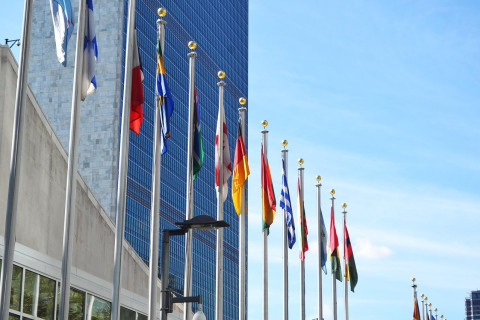
At a UN Economic Commission for Africa ministerial conference in Tangiers in April 2026, policymakers and technology leaders stated something that would have seemed abstract a decade ago: digital sovereignty is no longer optional. It is, in the words of Mozambique's Minister of Communications Américo Muchanga, "as vital today as electricity." The meeting did not produce binding commitments. But the language was significant. For the first time, African governments at ministerial level were framing data infrastructure as a strategic asset comparable to roads and ports — not a technology procurement question.
The numbers behind that framing are stark. Africa accounts for less than 2% of global data center capacity while hosting 17% of the world's population, according to a February 2026 analysis by New America. More concretely: 56% of African data is stored in servers in the United States, and a further 32% in Europe. For a country like the DRC — whose government databases, mobile banking records, customs systems, and increasingly AI-powered public services generate enormous volumes of digital information daily — the practical consequence is that sensitive national data sits in foreign jurisdictions, under foreign law, accessible to foreign intelligence services under foreign legal frameworks. That is not a theoretical sovereignty concern. It is an operational reality with direct implications for regulatory control, data security, and the terms on which African governments can negotiate with the technology companies whose infrastructure they depend on.
Who is building — and who is competing
The private sector has moved faster than governments on this question, and the resulting landscape is a direct reflection of the broader geopolitical competition playing out across the region. On the Western-aligned side, the most significant recent development for Central Africa specifically is Raxio Group's July 2025 launch of Angola's largest data center — a $30 million, 3MW, 800-rack Tier III facility in Cacuaco, Luanda, that also hosts Angola's Internet Exchange Point, allowing local internet traffic to remain in-country rather than routing internationally. The facility is Raxio's sixth on the continent, and the company now operates Tier III-certified carrier-neutral data centers in Uganda, Ethiopia, Mozambique, the DRC, Côte d'Ivoire, Angola, and Tanzania. In April 2025, the IFC committed $100 million in debt financing to Raxio — its largest-ever investment in African digital infrastructure — specifically to double the company's deployment capacity within three years, prioritising underserved markets including the DRC and Angola. In the DRC, Raxio's Kinshasa facility, with 1.5MW capacity and 400 server racks, is already operational, alongside a second facility by Open Africa Data Centres that has made the DRC one of the most recently added countries to the continent's carrier-neutral network.
Huawei occupies a different and more contested position. The Chinese company has relationships with more than 25 African countries and has committed to over $300 million in data center and cybersecurity investments across the continent by end-2026, according to a Georgetown University Africa-China Initiative analysis published in late 2025. It offers what Western competitors typically cannot: turnkey packages combining hardware, software, financing, and rapid deployment, backed by Chinese state capital that is not subject to the governance conditionalities attached to IFC or development bank financing. For governments in the CEMAC zone — CAR, Chad, Republic of Congo — already working with Chinese financing across their infrastructure portfolios, the Huawei model is familiar and trusted in a way that newcomers to the market are not.
Amazon, Microsoft, and Google control more than 60% of global cloud spending between them, and all three have African operations — but they are concentrated in South Africa, Kenya, Nigeria, and Egypt. Central Africa remains, for now, outside their direct infrastructure footprint, which is precisely why the Raxio model — carrier-neutral colocation that allows any cloud provider to connect — is commercially significant for the region. A data center that accommodates AWS, Azure, and Huawei Cloud simultaneously gives governments and businesses optionality that a single-vendor solution does not.
The sovereignty paradox
Here is the tension that the April 2026 Tangiers meeting identified but could not resolve: even when a data center is physically located inside an African country, digital sovereignty is not automatically achieved. Ownership may reside with foreign companies. Cloud services may operate under foreign legal jurisdiction. The terms on which a government can access its own data, or restrict foreign access to it, depend entirely on the contractual arrangements with the infrastructure provider — arrangements that smaller economies negotiate from a weak position. This is the "digital sovereignty trap" that New America's February 2026 analysis documents in detail: the top three cloud providers alone control more than 60% of global cloud spending, which means African governments have limited leverage when negotiating the terms of access. A government that hosts its tax records or hospital databases on AWS infrastructure in a domestic data center is not necessarily exercising more sovereignty over that data than if it hosted it in Virginia — the relevant questions are which law governs access, what audit rights the government retains, and whether the terms are negotiable. Most are not.
The DRC's Loi sur les Télécommunications provides a legal framework for data governance, but enforcement capacity and the technical ability to audit compliance are both limited. Thirty-six of 54 African countries have their own data protection laws, according to industry tracking — but having a law and having the capacity to enforce it against a major cloud provider are different propositions entirely.
What the competition is really about
Before getting to market projections, however, there is an elephant in the room that most investment prospectuses handle in a footnote: power. Tier III data centers require uninterrupted electricity supply 24 hours a day, 365 days a year, plus enormous cooling capacity in tropical climates. The DRC and Angola are both regions with chronic generation deficits and regular blackouts. Building a carrier-neutral Tier III facility in Kinshasa or Luanda means, in practice, building a sovereign power system alongside it — typically diesel generators, solar farms with large-scale battery storage, and dedicated substation connections. Raxio Angola's Cacuaco facility runs on two independent dedicated substations plus backup from two large generators, UPS devices, and batteries. That is not a footnote to the investment. It is a structural cost that shapes every economic calculation about digital infrastructure in the region. The battle for data sovereignty in Central Africa runs directly through the battle for stable, clean energy — and the latter is far from won. The second constraint is less visible but equally binding: people. Capital can build a server room. Maintaining 99.982% uptime — the Tier III standard — in the operating environment of Central Africa requires certified data center engineers, cybersecurity specialists, cooling system technicians, and network operations staff capable of replacing failed components under pressure, on shift, around the clock. That talent pool does not yet exist in sufficient depth in the DRC, Angola, or anywhere else in the region. The binding constraint on Central Africa's digital infrastructure buildout, over the next decade, will not be capital. It will be the availability of qualified local engineers to run these ecosystems after the ribbon is cut. Raxio's Angola facility has already appointed a local General Manager with 24 years of ICT sector experience — a deliberate and correct signal. Whether that approach scales across the region, and whether local universities and technical institutions can produce the talent pipeline these facilities will require, is a question no amount of IFC financing can answer on its own.
Africa's data center market is projected to grow from 0.4 GW of capacity in 2025 to up to 2.2 GW by 2030, requiring between $10 and $20 billion in investment, according to industry projections. That growth rate, combined with the continent's demographics and mobile-first digital economy, makes Africa the most significant underdeveloped data infrastructure market in the world. The countries and companies that build that infrastructure over the next five years will not just be selling server capacity. They will be establishing the technical standards, the legal frameworks, and the contractual norms under which African digital economies operate for decades. In Central Africa, that competition is just beginning. The DRC has data center capacity in Kinshasa. Angola has its new Raxio facility in Luanda. Cameroon and the Republic of Congo remain essentially without carrier-neutral infrastructure. For a region that has spent the better part of a century exporting raw materials while the processing and value-addition happened elsewhere, the risk of repeating that pattern in digital form — exporting raw data while the analytics, the AI models, and the economic value are captured abroad — is not abstract.
The April 2026 ministerial language about digital sovereignty as a prerequisite for economic security is the right diagnosis. The data centers being built in Kinshasa and Luanda are the right infrastructure response. Whether Central Africa can build the regulatory frameworks, the technical capacity, and the negotiating leverage to ensure that digital infrastructure translates into digital sovereignty, rather than just a new form of dependency with better latency, is the question the region has not yet answered.