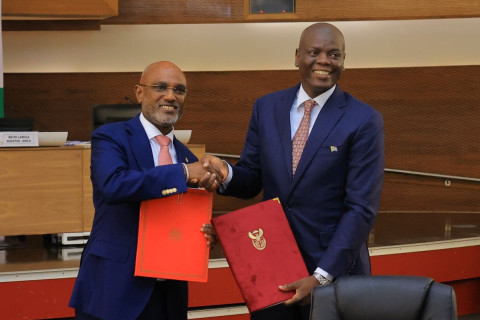
When Brazil's Petrobras signed strategic memorandums of understanding with Angola's national oil company Sonangol and upstream regulator ANPG, the agreements signaled more than a new commercial partnership. They reflected Brazil's decision to re-engage with Africa through one of its strongest competitive advantages: world-class deepwater expertise.
Angola is a natural place to begin. Although separated by the South Atlantic, the two countries share conjugate continental margins formed during the breakup of the ancient supercontinent Gondwana. As a result, Brazil's prolific pre-salt basins, including Santos and Campos, have long been regarded as geological analogs of Angola's Kwanza Basin. For petroleum geologists, the similarities are more than academic—they help explain why technologies developed on one side of the Atlantic can often be applied successfully on the other. That geological connection has become one of Petrobras' greatest strengths. Over the past two decades, the company has built a global reputation for developing some of the world's most complex ultra-deepwater fields, transforming Brazil's pre-salt discoveries into a benchmark for offshore production. Today, Petrobras is exporting not simply investment, but decades of technological know-how, subsea engineering, and operational expertise developed under some of the industry's most demanding conditions. The timing also reflects Angola's own priorities. As output from several mature fields gradually declines, Luanda is working to replenish reserves through new exploration while maximizing recovery from existing assets. At the same time, ANPG continues to promote new licensing opportunities, seeking partners capable of contributing advanced technology alongside long-term investment.
This is where Brazil offers a distinct value proposition. Unlike investors whose competitive edge lies primarily in financing large infrastructure projects, Petrobras brings practical solutions to geological and engineering challenges that closely resemble those encountered offshore Angola. In this partnership, technical capability may prove just as valuable as financial capital. The agreements also illustrate a broader evolution in Africa's external partnerships. Increasingly, governments are selecting partners for specific capabilities rather than broad geopolitical alignment. Infrastructure may come from one country, financing from another, while highly specialized engineering expertise is sourced from a third. Brazil is positioning itself within that increasingly specialized ecosystem.
The move also marks a return rather than a first arrival. Petrobras operated in Angola for decades before gradually scaling back its international portfolio to concentrate on developing Brazil's giant pre-salt discoveries, including Lula and Búzios. Having established itself as one of the world's leading deepwater operators, the company is now returning to Angola with a far stronger technological portfolio than when it first entered the market.
Whether these agreements ultimately develop into major commercial projects remains to be seen. Yet they already highlight an important shift in how international partnerships are taking shape across Africa's energy sector. Competitive advantage is no longer determined solely by the amount of capital an investor can deploy. Increasingly, it also depends on the specialized knowledge and technical capability that partners bring to the table—and in deepwater offshore development, Brazil has few peers.