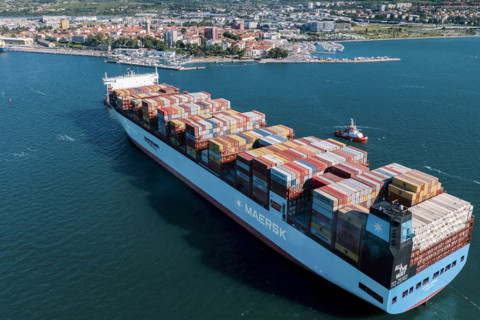
Some shifts happen quietly, without fanfare, and you only understand their weight when you step back and look at the full picture. In February 2026, a tanker left the coast of the Republic of Congo carrying the first cargo of liquefied natural gas from Eni's new Nguya FLNG platform. No breaking news alerts. No market-moving headlines. Just a ship, a cargo, and a country that had spent decades sitting on gas reserves it mostly burned off in flares — now an LNG exporter.
President Sassou Nguesso was at the ceremony in Pointe-Noire. So was Eni CEO Claudio Descalzi. The international press covered it briefly and moved on. That was a mistake.
Nguya is the second floating liquefaction unit of the Congo LNG project, delivered in just 35 months — ahead of schedule by industry standards that typically run closer to five years. Together with the Tango FLNG platform, operational since late 2023, the project now has a combined capacity of 3 million tonnes of LNG per year, equivalent to 4.5 billion cubic metres of gas. For a country of fewer than 6 million people, that number is not an incremental improvement. It is a different economic identity.
Eni has been in Congo for 55 years. It already supplies gas to the Centrale Électrique du Congo, which generates roughly 70% of the country's electricity. The relationship is old and deep. What's new is the timing of the export push — and it couldn't be better calibrated. The 2026 Middle East crisis sent Brent swinging from $81 a barrel in early March to $112 on March 12 before settling near $98. European and Asian buyers, rattled by supply disruptions around the Strait of Hormuz and the Red Sea, are actively hunting for alternatives. Congo's Atlantic coast is geographically clean — no choke points, no geopolitical landmines on the shipping lane.
The offshore sector around Pointe-Noire is moving fast. TotalEnergies just secured the Nzombo exploration licence. Perenco is redeveloping the Kombi-Likalala-Libondo II field. And QatarEnergy, which signed its own offshore exploration licence in Congo earlier this year, brings Gulf sovereign capital into a space previously dominated by European majors — with a very different set of long-term ambitions.
There is one thing this LNG story does not guarantee, and it matters more than the export figures: that the money finds its way to the people who need it. Congo's public debt stands at 97.4% of GDP. The government issued three Eurobonds in four months to refinance short-term obligations. LNG revenues will ease the pressure — the question is whether they ease it for the state or just for its creditors. That distinction is invisible from the deck of a tanker leaving Pointe-Noire. But it will determine whether this decade becomes a turning point for Congo, or just another chapter in a long story of resource wealth that somehow never quite reached the country it came from.