In the offshore energy business, projects run late and come in over budget so consistently that it barely counts as news anymore. TotalEnergies' Kaminho development in Angola's Kwanza Basin just did the opposite of both. First oil is now expected in the fourth quarter of 2027, a full quarter ahead of the original first-quarter-2028 target set at the project's Final Investment Decision in May 2024. Peak production has been revised upward too, from 70,000 to 75,000 barrels of oil per day. The floating production and storage vessel that will anchor the whole project reached 50% completion in April, according to Angola's oil and gas regulator, ANPG. For a $6 billion deepwater development — TotalEnergies' first in a basin the company itself has called a new frontier for Angola — coming in early rather than late is the kind of signal that gets noticed far beyond the project site.
Why this project matters beyond its own numbers
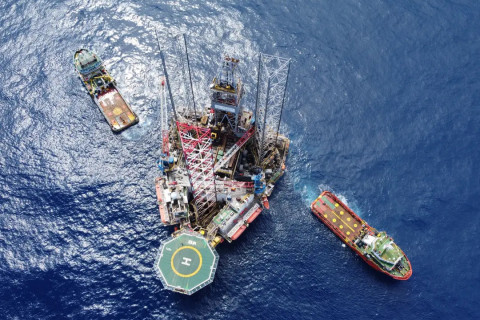
Kaminho is not just another offshore well. It is the first major deepwater development in the Kwanza Basin, targeting the pre-salt Cameia and Golfinho fields roughly 100-150 kilometres off Luanda, in water depths of 1,700 metres. TotalEnergies holds 40%, alongside Petronas (40%) and Sonangol (20%) — Angola's state oil company retaining a fifth of a project it did not have to fully carry the capital risk for. The FPSO itself, a converted very large crude carrier being finished at a Chinese shipyard before final assembly work in Angola, will become TotalEnergies' seventh floating production unit in the country once operational — a scale of accumulated operational presence that few international majors match anywhere on the continent.
The technical specifications matter for a different reason: they reflect where global capital is actually willing to flow in 2026. Kaminho was designed from FID with a breakeven cost under $30 a barrel and carbon intensity of 16 kg CO2e per barrel of oil equivalent — an all-electric FPSO with full associated-gas reinjection, engineered to eliminate routine flaring. In an investment environment where international oil companies face growing pressure to justify new fossil fuel developments on both economic and emissions grounds simultaneously, a project that clears both bars is precisely the kind of asset that continues attracting capital when more marginal developments do not.
The local content detail that says more than it seems
One specific milestone from the construction process is worth pulling out on its own. In June, TotalEnergies and its partners loaded the FPSO's riser protector — an 80-metre, 300-tonne structure — at the Petromar shipyard in Ambriz, Bengo province, built entirely inside Angola as part of the project's local content commitments. A single steel structure is not, on its own, an economic transformation. But it is a concrete, verifiable data point in a conversation — about whether Angola's energy sector actually builds domestic industrial capacity or simply extracts and ships — that we have covered extensively in this region, from Cameroon's local content push in mining to the Republic of Congo's parallel efforts in its LNG sector. Angola appears to be applying the same logic to its flagship deepwater project, embedding fabrication work domestically rather than treating local content requirements as a box to check offshore.
How this fits the broader Angola story
Kaminho's acceleration lands at a moment when Angola has been actively rewriting its own energy narrative. We have covered the country's December 2023 exit from OPEC and the resumption of construction at the Cabinda refinery — decisions Angolan officials have argued were vindicated by this year's Middle East-driven oil price volatility, since Angola now sets its own production levels without cartel quota constraints. A major deepwater project running ahead of schedule and with an upgraded output target reinforces that same narrative at the operational level: Angola is not simply talking about being an attractive, well-run hydrocarbons market. On this project, at least, the delivery data backs it up. That matters for the wider investment picture. TotalEnergies has separately extended its operatorship of Angola's Block 32 through 2043 and expanded exploration acreage with ExxonMobil in the Benguela and Namibe basins — decisions that reflect a company betting on a multi-decade horizon in the country, not just completing a single project and moving on. When a major operator extends its longest-dated commitments in a market at the same time one of its flagship projects is beating its own construction schedule, the two signals reinforce each other in a way that matters more to capital allocation committees than either one would in isolation.
What to watch
The real test comes over the next six quarters. Installation activity on Kaminho's subsea infrastructure is scheduled through 2026 and 2027, the period where deepwater projects most commonly encounter the weather delays, vessel scheduling conflicts, and supply chain bottlenecks that erase early schedule gains. ANPG's reporting cadence on construction milestones — the kind of transparent, regulator-verified progress updates that gave the market visibility into this month's acceleration news — will be the clearest signal available to investors and regional governments watching whether Angola's upstream sector can consistently deliver on the timelines it sets, not just on this one project, but as a pattern across the country's broader deepwater pipeline.