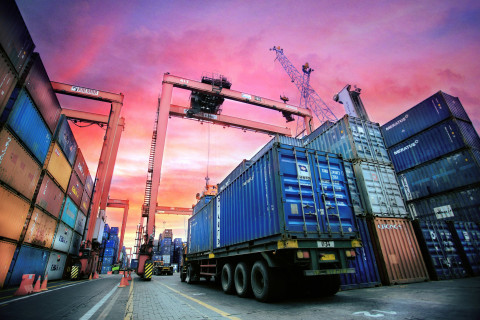
Cameroon is expanding the Port of Douala with a roughly $500 million mixed bulk terminal designed to increase cargo capacity and strengthen the country’s position as a logistics gateway for Central Africa.
Developed by Africa Ports Development (APD) in partnership with the Port Authority of Douala, the project covers 36 hectares at Bonabéri on the right bank of the Wouri River. Plans call for up to 900 meters of quay infrastructure, storage facilities and connections to road and rail networks. The broader development is designed to add as much as 8 million tons of annual handling capacity once fully built out.
AD Ports Group of the United Arab Emirates joined the project in February through a 30-year concession to design, build and operate a new dry bulk terminal. The Abu Dhabi-based operator and two other UAE investors will hold a combined 60% of the operating company, while APD retains 40%. AD Ports has an effective economic interest of 51%.
AD Ports expects to invest about $87 million . The initial facility will include two berths and around 450 meters of quay wall, with capacity to handle approximately 4 million tons of dry bulk cargo a year, including clinker, gypsum, fertilizer and grain. Construction was scheduled for 2026–2028.
Progress has not been straightforward. Africa Intelligence reported in July that the transaction between AD Ports and APD had still not reached financial closing, with negotiations over the finalization of the deal delaying construction linked to the new concession. That does not mean the broader terminal project has been canceled or permanently suspended.
Work on the wider development had already moved into implementation before the UAE operator joined the concession. The Port Authority of Douala presented the project as entering its implementation phase in 2025, while APD has continued to promote the terminal as a major expansion of the port. The 4-million-ton figure attached to AD Ports’ first phase therefore sits within the larger project rather than replacing its broader 8-million-ton capacity target.
Douala’s importance extends far beyond Cameroon’s borders. The port is a major entry point for goods destined for the country’s domestic market and serves as a transit corridor toward landlocked Chad and the Central African Republic. AD Ports says Douala handles about 80% of Cameroon’s bulk cargo and 85% of its national trade volumes, highlighting the scale of the bottlenecks that additional specialized capacity could help address.
For the UAE, the project adds another Central African position to AD Ports’ growing network of ports and logistics assets across the continent. For Cameroon, its significance is more immediate: a larger and more specialized Douala could improve the movement of industrial and agricultural commodities while giving the country a stronger role in regional supply chains.
The next test is execution. Finalizing the UAE-backed concession and moving the first phase into full construction will determine how quickly Douala can translate a major infrastructure plan into additional capacity for Cameroon and its landlocked neighbors.