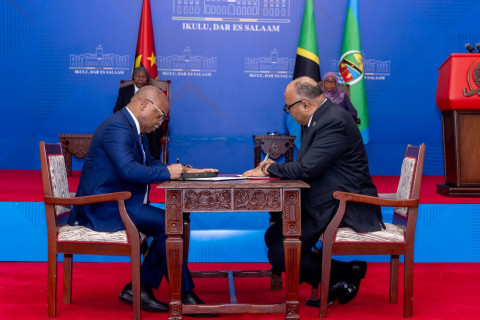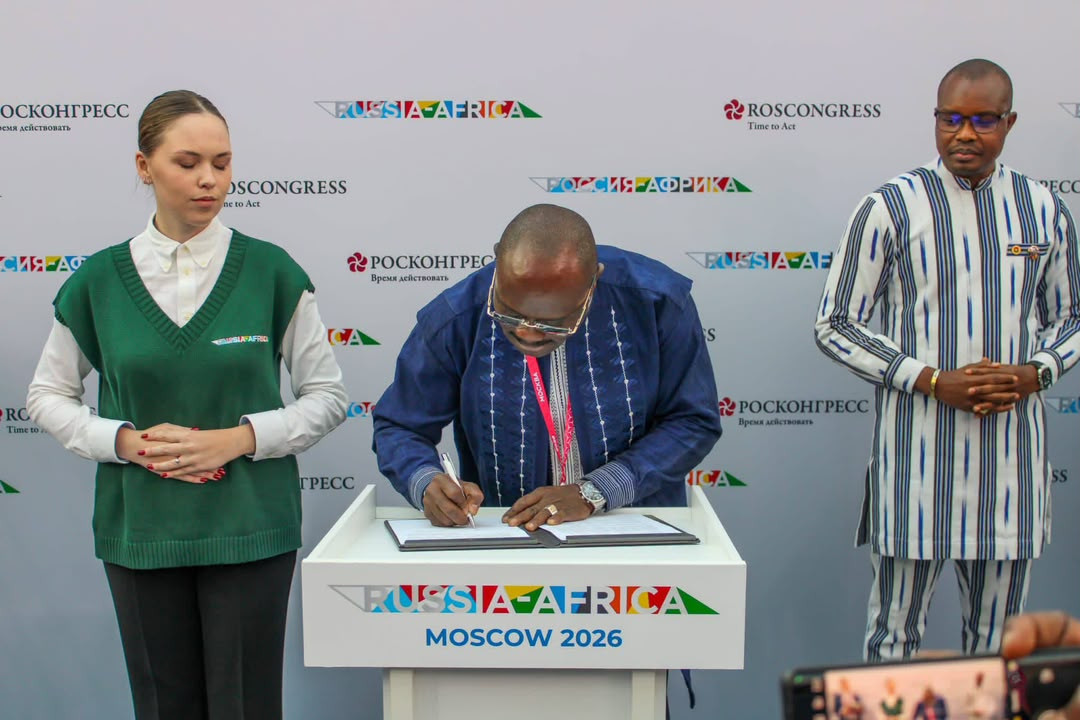
The Confederation Bank for Investment and Development of the Alliance of Sahel States (BCID-AES) has signed a memorandum of understanding with Russia’s state development corporation VEB.RF, deepening financial cooperation between Moscow and the three-country Sahel bloc.
The agreement was concluded in the presence of Burkina Faso’s Prime Minister Rimtalba Jean Emmanuel Ouedraogo and Russian Deputy Prime Minister Alexander Novak, on the sidelines of the Russia-Africa Economic and Humanitarian Forum in Moscow, on October 28, according to the website of Burkina Faso’s government.
BCID-AES president Serge Bayala said cooperation would focus on capacity-building, structuring investment projects, jointly financing major confederal projects, and potentially facilitating trade-payment mechanisms.
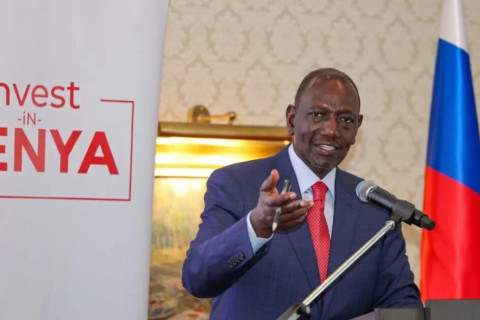
The signing took place as President Vladimir Putin addressed the third Russia-Africa summit, which drew delegations from 48 African countries, including 22 heads of state. He said that Russia-Africa trade exceeded $27 billion in 2025 and called for it to more than double and surpass $50 billion in the near future.
He also promoted Russian cooperation in grain, fertilizer, energy, transport, technology and localized manufacturing, framing Moscow as an alternative partner to Western financial institutions.
The accord positions VEB.RF as a prominent external partner for the AES’s flagship development bank. It also gives the Alliance of Sahel States—formed by Burkina Faso, Mali and Niger—a framework for mobilising capital for infrastructure and productive-sector projects across the confederation.
BCID-AES was established by the three AES states in December 2025 with authorized capital of about $895 million. Its mandate is to channel financing into infrastructure and economic-development initiatives in Burkina Faso, Mali and Niger.
Officials have identified agriculture, agro-industry, mining, energy and infrastructure as likely priority areas. The partnership is intended to support regional integration and industrial development, while giving the Sahel states access to Russian project expertise and financing channels.