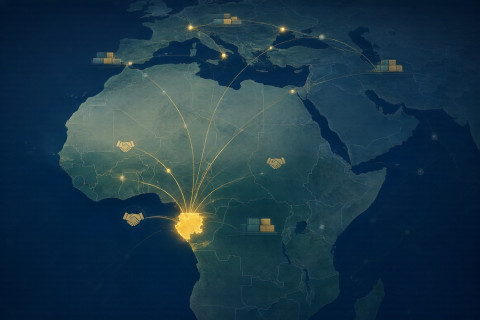
Twenty years ago, discussions about foreign influence in Central Africa usually revolved around a handful of major powers. Today, that picture no longer reflects reality.
The explanation lies not only in Central Africa's growing economic importance, but also in the changing ambitions of a new generation of middle powers. Countries such as the United Arab Emirates, Türkiye, and India have reached a stage where domestic markets alone can no longer sustain their long-term economic ambitions. Expanding overseas has become an economic necessity rather than a diplomatic luxury.
For many of these countries, the challenge is structural. Years of rapid economic growth have produced globally competitive companies, accumulated large pools of investment capital, and created industries capable of operating far beyond national borders. Sustaining that momentum increasingly depends on securing new markets, new investment opportunities, and long-term international partnerships.
Central Africa is becoming part of that strategy.
The region offers something few markets can match simultaneously: abundant natural resources, one of the world's youngest populations, rapidly expanding infrastructure needs, and significant long-term demand for energy, logistics, construction, healthcare, telecommunications, and industrial development. For governments seeking to internationalize their economies, these are commercial opportunities before they are geopolitical ones.
The United Arab Emirates illustrates this transformation particularly well. With a relatively small domestic market, it has spent the past two decades building globally competitive logistics companies, sovereign wealth funds, energy firms, and infrastructure operators. Continued expansion increasingly depends on overseas investment, including across Africa's Atlantic coast, where Emirati companies are strengthening their presence in ports, logistics, and transport infrastructure.
Türkiye's trajectory follows a different path but reflects similar economic logic. Turkish construction companies, manufacturers, airlines, healthcare providers, and defense firms have steadily expanded abroad as domestic industries search for new markets. Central Africa has become an increasingly attractive destination for that outward expansion, supported by a growing diplomatic network and expanding commercial ties.
India's engagement is likewise becoming more diversified. While its historical relationship with Africa has often centered on trade and development cooperation, New Delhi is increasingly seeking long-term partnerships in pharmaceuticals, digital technology, education, and critical minerals as part of its broader global economic strategy.
Unlike traditional great-power competition, these countries rarely attempt to dominate every sector simultaneously. Instead, they focus on areas where they possess clear competitive advantages. Their influence is measured less by military presence or ideological alignment than by their ability to finance projects, build infrastructure, transfer technology, and support industrial development.
This represents a broader shift in international relations. Economic specialization is becoming an increasingly important source of diplomatic influence. Countries no longer need the world's largest economies or militaries to become consequential international actors. In many cases, expertise in logistics, construction, finance, technology, or energy can translate into meaningful geopolitical influence.
The world's major powers remain indispensable players in Central Africa. China, the United States, the European Union, and Russia continue to shape many of the region's strategic decisions. What has changed is that they no longer operate in a field of their own.
Growing role of middle powers reflects a larger transformation in the global economy. As their ambitions increasingly outgrow the limits of their domestic markets, overseas expansion is becoming essential to sustaining growth and supporting national industries. Central Africa is emerging as one of the regions where that transformation is becoming most visible—not because it has suddenly become the center of global politics, but because it offers opportunities that align with the economic priorities of a new generation of internationally ambitious states.