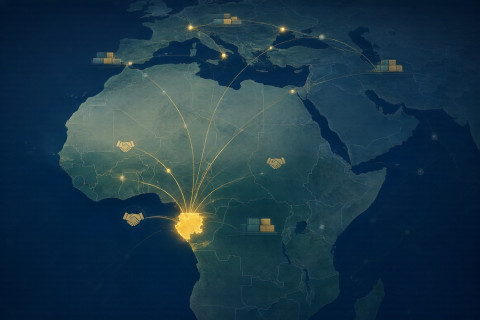
Central Africa's diplomatic landscape is becoming more diverse. While China, the United States, Europe, and Russia remain the region's most influential external players, a growing number of middle powers are carving out their own roles through targeted economic partnerships and specialized expertise. Countries such as the United Arab Emirates, Qatar, Singapore, and Türkiye are expanding their presence without trying to compete head-on with the world's largest powers. Instead, they focus on areas where they have proven experience—from logistics and investment to mediation, infrastructure, and trade.
The Gulf states offer perhaps the clearest example of this approach. The UAE has become one of Africa's leading investors in ports, logistics, renewable energy, and industrial infrastructure, while Qatar has strengthened its position as both a strategic investor and an active diplomatic mediator. Their engagement is typically driven by commercial opportunities and long-term partnerships rather than broader geopolitical agendas.
Singapore has followed a different path. While Singaporean companies actively invest in ports and industrial zones across Africa, their comparative advantage increasingly lies in improving how those assets operate. Its expertise in port management, digital trade, and logistics has become a valuable export alongside its investments. Projects such as support for the Maritime Single Window initiative linked to Angola's Lobito Corridor illustrate how Singapore is helping modernize trade by making existing infrastructure more efficient. What makes these partnerships notable is not simply the sectors they target, but the flexibility they offer. Rather than relying on a single international partner, Central African governments increasingly combine expertise from different countries to meet specific needs. One partner may finance infrastructure, another may operate a port, while a third helps improve customs systems or digital trade platforms.
This does not diminish the importance of larger powers. China remains Africa's largest trading partner and a major source of infrastructure financing. Europe continues to play a leading role in development finance, while the United States remains an important security and commercial partner. What is changing is the range of options available to African governments. As more middle powers expand their engagement, countries across Central Africa have greater flexibility to diversify partnerships, negotiate better terms, and draw on specialized expertise instead of relying too heavily on any single partner. Influence in Central Africa is increasingly shaped not only by the size of a country's economy or military, but also by its ability to deliver practical solutions that match the region's evolving priorities. In today's diplomatic landscape, expertise, flexibility, and economic value are becoming just as important as geopolitical weight.