UN Security Council: Civic Space Narrowing Across Central Africa
United Nations does not often speak in direct language when it comes to African governments. That is why this week's warning to Security Council deserves attention.
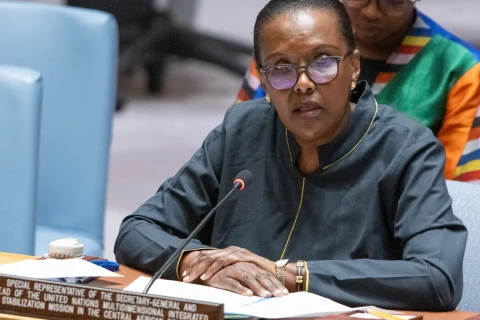
On June 9, senior UN official briefing 15-member Security Council on latest report on Central Africa described what she called worrying trend — increasing restrictions on civil and political rights across several countries in region. Her message was clear: if this continues, it will not just shrink civic space. It will eventually produce conflict.
The language was diplomatic. The meaning was not.
In same briefing, official described continuing suffering of civilians in Lake Chad Basin — parts of Chad and Cameroon — from attacks by Boko Haram-affiliated groups. She acknowledged that Multinational Joint Task Force operating across Cameroon, Chad, Nigeria and Benin is doing necessary work, but added that military response alone cannot solve what is fundamentally a development and governance crisis. Someone needs to fund Lake Chad Basin Commission's cross-border programmes. So far, not enough people have.
And then there is Sudan — now in fourth year of war. More than 900,000 Sudanese refugees and 300,000 Chadian returnees have crossed into Chad since April 2023. These are not numbers. They are families who left everything behind, and they are now living in country that does not have resources to take care of them.
Cameroon: 16 Soldiers Dead in Ukraine — And Nobody Is Explaining How
This story has been circulating quietly for weeks. Now it has official confirmation — and official silence.
Cameroonian authorities have confirmed that 16 of their nationals were killed while fighting in Russia-Ukraine war. They confirmed deaths. They have not explained how these men ended up on front lines of conflict thousands of kilometres from home.
What is understood from regional reporting is that individuals were recruited through Russian-linked networks — some likely connected to Africa Corps, organisation that replaced Wagner Group and maintains active presence across region including in CAR. Whether they went voluntarily, whether they understood what they were signing up for, whether families were told the truth — none of this has been addressed publicly.
Cameroon is not alone in this. Same pattern has been documented in other African countries. But sixteen confirmed dead is not an abstraction. These were people with names and families, and their government has so far offered no real accounting of what happened to them.
CAR: Sanctions Extended, Situation Unchanged
Central African Republic came before UN Security Council in February 2026 for its regular briefing — and picture presented was familiar.
MINUSCA mission head Valentine Rugwabiza briefed Council members on latest report covering developments since October 2025. Peacebuilding Commission also presented its assessment.
Sanctions against armed groups operating in CAR — asset freezes, travel bans, arms embargoes — were extended until July 2026. These measures have been in place in various forms for years. They exist because armed factions continue to exploit CAR's natural resources and use country's territory as operational base.
Year after year, mandate gets renewed. Situation on ground changes slowly if at all. For people living outside Bangui — which is most of country — that gap between Security Council resolutions and daily reality is very large.
DRC-Burundi: Conflict Nobody Is Watching
Everyone has been watching DRC-Rwanda. Meanwhile, another potential crisis has been quietly building.
International Crisis Group is among analysts now flagging risk of escalation between DRC and Burundi — distinct from Rwanda track but potentially just as dangerous. Countries with relationships on both sides — Kenya, Angola, Uganda — are being urged to engage in quiet diplomacy before situation reaches point where quiet diplomacy is no longer enough. Simple measures like reopening borders, which would actually benefit both economies, are sitting unused.
Angola's position here is worth noting. Luanda has built relationships across every dividing line in Great Lakes region — with Kigali, with Kinshasa, with Bujumbura. That gives Angola leverage that almost nobody else has. Whether it will be used before next crisis erupts is open question.
The Bigger Picture
African Union has spent years building institutional framework for peace and security — conflict prevention mechanisms, early warning systems, rapid response capacity. In 2026, that framework is being tested simultaneously on multiple fronts across continent
Central Africa alone presents four countries in various states of active conflict or serious instability. Each has its own logic, its own actors, its own history. What connects them is that in each case, population is paying price for failures — of governance, of diplomacy, of development — that were visible long before they became emergencies.