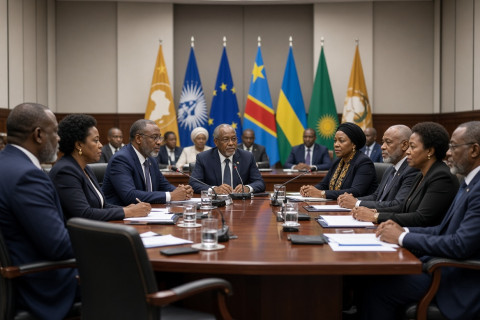
President Brice Clotaire Oligui Nguema's three-day state visit to France from July 19 to 22 brought an unusually sensitive issue into the background of otherwise strategic talks: the continued detention of Alain-Claude Bilie-By-Nze, Gabon's former prime minister and the runner-up in the country's first presidential election after the August 2023 coup.
Bilie-By-Nze's lawyer, Arthur Vercken, called on French authorities to use their diplomatic influence to raise the case during the visit, describing his client's detention conditions as degrading and the proceedings against him as politically motivated. Gabonese authorities have presented the case as a matter for the judiciary, while Oligui Nguema has denied ordering or influencing the proceedings.
How a former prime minister came to be detained
Bilie-By-Nze served as Ali Bongo's last prime minister before the August 2023 military takeover ended the Bongo family's 56-year rule. He subsequently took an unusual political path for a former senior official of a military-led transition by challenging Oligui Nguema in the presidential election.
In the April 2025 election, Oligui Nguema won 94.85% of the consolidated vote, according to revised official results, while Bilie-By-Nze finished second with 3.11%.
Bilie-By-Nze subsequently remained one of the most prominent public critics of the authorities. His political activity included criticism of the government's suspension of social media platforms in February and opposition to constitutional and political reforms introduced during the post-coup transition. He was arrested at his home on April 15, 2026, by agents of Gabon's General Directorate of Investigations and placed in pre-trial detention the following day. The case concerns allegations of fraud and breach of trust linked to a five-million-CFA-franc debt (roughly $8,000–$9,000, depending on the exchange rate) dating back to 2008, when Bilie-By-Nze was involved in organizing a national cultural festival.
His party, Ensemble pour le Gabon, described the arrest as brutal and said he spent his first 24 hours without access to a lawyer. His legal team has argued that the allegations are too old to be prosecuted under Gabonese law. On June 2, the Libreville Appeals Court rejected the defense's request to invalidate the proceedings, leaving Bilie-By-Nze in detention.
Oligui Nguema has rejected suggestions that he personally intervened in the case. In comments to France 24, he described the matter as a private judicial proceeding and said Gabon's judiciary operates independently of the presidency.
Why the case matters in Paris
The detention added a politically sensitive dimension to a visit otherwise focused on strengthening France's relationship with Gabon.
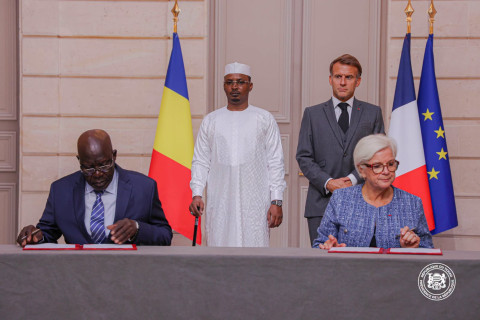
The two sides discussed economic cooperation, manganese processing and defense ties, including the future organization of France's military presence in Gabon. The economic agenda also produced a concrete agreement: Gabon, Eramet and Eramet Comilog signed a protocol aimed at expanding local manganese processing, with a target of reaching processing capacity of up to 700,000 tonnes a year by the end of 2031.
For France, Gabon remains a strategically important partner in Central Africa, but the relationship is no longer defined solely by the country's historical links with Paris. Libreville is simultaneously expanding its engagement with the United Arab Emirates, China and other external partners. That diversification gives Gabon greater room for diplomatic maneuver and reduces its dependence on any single external partner. For France, it creates a more complex balance between preserving economic and strategic ties and responding to concerns surrounding political rights and the treatment of opposition figures. The question is therefore not simply whether France supports or opposes Oligui Nguema's government. It is whether French officials can raise the case of Bilie-By-Nze while maintaining a relationship that Paris clearly wants to strengthen.
A test for the post-coup transition
The detention has become a reference point in the debate over Gabon's political trajectory since the 2023 coup. The military takeover ended the Bongo family's long rule and was followed by a transition that culminated in the 2025 presidential election, giving Oligui Nguema a constitutional mandate. The treatment of his most prominent political challenger, however, continues to raise questions about how open the new political order will ultimately be.
The case itself does not establish a systematic policy of judicial persecution. But its timing has become central to the dispute. A private financial claim dating back to 2008 resurfaced after Bilie-By-Nze had become one of the government's most visible critics. His lawyers and supporters interpret that timing as evidence of political pressure, while the authorities maintain that the case belongs in the courts. The wider context also matters. Concerns over prison conditions, access to legal assistance and prolonged pre-trial detention have contributed to broader scrutiny of Gabon's justice system.
What comes after the Paris visit
There is no clear public indication that France made Bilie-By-Nze's detention a formal part of the July talks. The question of whether French officials raised the matter privately therefore remains open. The political contrast, however, is difficult to ignore. Oligui Nguema was received in France with the formal honors accorded to a head of state, while the man who finished second in the election that gave him a constitutional mandate remained in detention in Libreville awaiting the next stage of a case his lawyers describe as politically driven and legally outdated.
For Gabon, the case has become part of a larger test of what the post-coup transition will ultimately mean for political competition and the rule of law. For France, it illustrates the increasingly complicated task of maintaining influence in a Central African partner that is simultaneously strengthening its ties with a wider range of international actors.