Central African Republic President Faustin-Archange Touadéra faces a delicate diplomatic balancing act as Bangui deepens defense and intelligence ties with the Democratic Republic of the Congo (DRC) while maintaining a close relationship with Rwanda.
Rwandan President Paul Kagame has expressed displeasure over the partnership between Bangui and Kinshasa, according to Africa Intelligence, which reported on October 15 that Rwanda’s military presence in the Central African Republic (CAR) complicates Touadéra’s position.
The reported tensions follow a series of agreements between the CAR and the DRC aimed at strengthening military training, intelligence sharing and coordination along their common border. The new arrangements deepen ties between the neighboring countries while Rwanda remains an important partner for the government in Bangui.
Bangui and Kinshasa Expand Military Ties
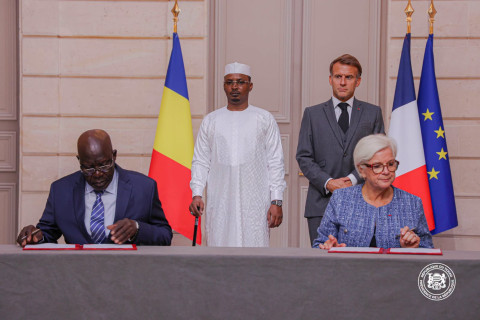
The CAR and the DRC have worked to formalize their military partnership since signing a bilateral agreement on October 18, 2024. On August 21, 2026, the two countries signed memorandums of understanding covering military training and intelligence sharing, according to Radio Okapi.
The arrangements provide for real-time exchanges of strategic and operational information on cross-border movements, as well as joint measures targeting vulnerable areas along their more than 1,600-kilometer border. The two governments say they want to curb armed-group activity and address incursions linked to armed pastoralist movements.
The agreements also reflect Kinshasa’s interest in preventing armed groups from using neighboring territory to threaten the DRC. For Bangui, closer coordination with Kinshasa offers another channel for addressing cross-border threats.
Rwanda’s Military Presence Adds Diplomatic Complexity
Rwanda maintains troops in the CAR under two separate arrangements: its contribution to the United Nations Multidimensional Integrated Stabilization Mission in the Central African Republic (MINUSCA) and a bilateral defense agreement with Bangui. The two deployments have distinct mandates, while Rwanda’s broader military relationship with the CAR includes training and support for Central African armed forces.
Against this backdrop, Kagame’s reported reaction highlights the diplomatic sensitivities surrounding the new partnership. However, available public reports do not establish that the CAR–DRC agreements are directed against Rwanda or that Touadéra intends to scale back ties with Kigali.
For the Central African president, the challenge is to expand cooperation with a neighboring country while preserving a relationship with an established military partner. His government must also navigate the wider regional dynamics surrounding armed groups, border management and competing diplomatic interests.
The development illustrates how defense partnerships in Central Africa increasingly overlap. Bilateral arrangements can help neighboring governments exchange intelligence and coordinate responses to shared threats, but they may also raise concerns among other regional partners.
Whether Bangui can deepen ties with Kinshasa without straining relations with Kigali will depend on how the new arrangements are implemented and how the three governments manage their respective interests.