On February 4, 2026, Secretary of State Marco Rubio and Vice President JD Vance unveiled FORGE — the Forum on Resource Geostrategic Engagement — the successor to the Biden-era Minerals Security Partnership and the clearest sign yet that US critical minerals policy in Africa has moved from policy debates to institutional strategy. Alongside FORGE came Project Vault, a $12 billion strategic stockpile designed, in the administration's words, as a "civilian-industrial reserve", positioning Washington as a institutional buyer capable of influencing market prices rather than negotiating deals on a case-by-case basis. This is not a government still searching for a strategy. Within a matter of months, Washington created two new institutions intended to reshape its critical minerals policy. Yet even with those initiatives in place, it has not displaced China's foothold in Central Africa's mineral economy, because that position was never built to be challenged by a single competing initiative, however well funded.
FORGE's early impact: the Orion–Glencore deal
The clearest expression of FORGE's early impact is the Orion Consortium–Glencore memorandum of understanding, which gave US-aligned capital a formal entry point into the DRC Copperbelt — the same corner of the mining sector where Gecamines has simultaneously built trading relationships with Chinese partners. The DRC has reportedly sent Washington a shortlist of state-owned mining assets available for partnership, signaling that Kinshasa views FORGE as another bargaining chip, rather than a framework to embrace exclusively. That distinction is crucial because it challenges the simplistic notion that "Washington hesitates, Beijing moves." The DRC is not waiting to see which power prevails. It is actively engaging both frameworks simultaneously because both are now real, funded, and competing for access to the same copper and cobalt reserves. The DRC alone accounts for roughly 70 % of global cobalt production, according to multiple 2026 industry assessments.
The Lobito Corridor's strategic paradox
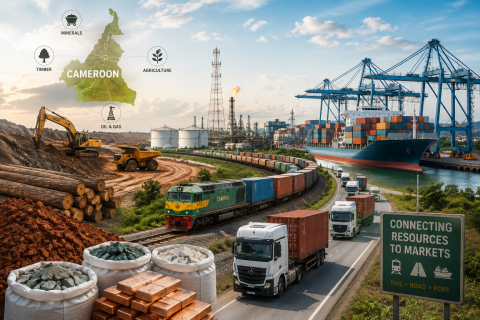
The irony at the center of Washington's flagship infrastructure strategy is difficult to ignore. The Lobito Corridor, a $6.6 billion effort intended to provide an alternative to Chinese-controlled export routes, depends commercially on a single anchor mining operator — Ivanhoe Mines — whose ownership structure itself includes significant Chinese capital. In other words, the corridor designed to reduce dependence on Chinese-linked supply chains is, at its commercial core, supported in part by the same capital it was designed to counterbalance. China's insurance policy against Lobito's success runs through a different corridor altogether. Beijing has spent years strengthening its position along TAZARA, the Tanzania–Zambia railway connecting the same Copperbelt to the Indian Ocean through Dar es Salaam — a route that analysts have examined as a potential complement to, rather than a direct competitor with, Lobito. Analysts at the Payne Institute for Public Policy note that this gives Chinese-owned mining operations alternative export options "regardless of the Lobito Corridor's success", meaning Washington's infrastructure strategy does not fundamentally threaten China's underlying market position even if Lobito succeeds on its own terms.
Sicomines: renegotiated, not replaced
The same pattern of adaptation, rather than retreat, is visible in the renegotiation of the Sicomines joint venture, the resource-for-infrastructure agreement that has anchored China–DRC mining relations since 2008. After years of pressure from Kinshasa over the original terms, Chinese partners agreed to a new $7 billion infrastructure commitment alongside a 1.2% annual royalty structure.
This is not the behavior of an investor retreating under competitive pressure. It is the behavior of one recalibrating its commercial relationship to preserve a strategic position developed over nearly two decades. China's continuity has been secured through renegotiation rather than confrontation.
What this means for Central African governments
The same logic extends far beyond the DRC. Across Central Africa, governments increasingly understand that competition among external powers represents leverage rather than risk. Angola simultaneously welcomes Chinese infrastructure financing, American interest in critical minerals, and growing economic engagement from Gulf investors without meaningfully prioritizing any single partner. Elsewhere, Gulf sovereign wealth funds continue expanding logistics and industrial investments, while Turkish operators strengthen their regional presence. The objective is no longer to choose sides, but to maximize negotiating power by working with all of them. That strategy, however, depends on institutions capable of managing competing interests. Without transparent procurement systems, effective regulation, and consistent long-term planning, multiple investment offers can easily result in overlapping projects, inconsistent policies, or new forms of dependency. Negotiating leverage only creates value when governments possess the institutional capacity to translate it into enforceable commercial outcomes.
The DRC–Rwanda peace framework illustrates that challenge particularly well. According to the Foreign Policy Research Institute's 2025 assessment, Washington's security-and-minerals initiative reportedly included Congolese offers of exclusive US mineral rights in exchange for security assistance against M23 — an arrangement that ultimately did little to reduce violence in the eastern provinces where those same mineral concessions are located.
Competition between Washington and Beijing creates leverage for African governments only when it produces enforceable commercial agreements and sustainable security conditions on the ground. The shortlist of mining assets sent to Washington, together with the renegotiated Sicomines agreement with Beijing, demonstrates that Kinshasa understands how to use that leverage. Neither development, however, has resolved the conflict that continues to determine whether any mining company — American, Chinese, or Congolese — can safely operate where the minerals actually lie.