For years, international counter-terrorism strategies have treated violent extremism as a purely ideological or socio-political disease. Billions of dollars have been spent on military operations, intelligence sharing, and deradicalization programs. Yet, in the Lake Chad Basin—spanning Chad, Cameroon, Niger, and Nigeria—insurgencies like Boko Haram and the Islamic State West Africa Province (ISWAP) stubbornly refuse to die.
To understand why, one must look past the religious slogans and examine the changing hydrography of the region. In 2026, the most effective recruiting tool for terrorists is not a holy book; it is the retreating shoreline of Lake Chad. Climate change has ceased to be an environmental abstract—it has been thoroughly weaponized.
The Myth of the Shrinking Lake vs. The Reality of Chaos
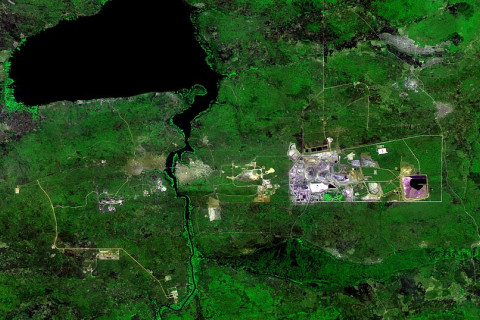
For a long time, the dominant narrative was that Lake Chad was simply vanishing. The reality, as mapped by modern satellite data, is more complex but equally devastating: the lake is fracturing into highly unpredictable, seasonal pools, plagued by extreme shifts between severe droughts and catastrophic floods.
This environmental instability has fundamentally broken the traditional economic contract of the region. For generations, local societies relied on a delicate balance between Fulani herders, Hausa fishermen, and Kanuri farmers. As water sources shift unpredictably, this balance has collapsed into violent communal clashes over arable land and grazing rights.
This is where the state failed, and where the jihadists saw a massive market opening.
Terrorists as "Resource Managers"
The African Union’s Peace and Security Council recently held a landmark session highlighting climate change as a core driver of the Sahelian crisis. Groups like ISWAP have shifted from primitive banditry to acting as a perverse, de facto governing authority that fills the environmental vacuum left by weak central governments.
Instead of just terrorizing civilians, these factions have developed a sophisticated strategy of environmental governance:
- Taxing the Lifeline: In the islands and recesses of the lake, ISWAP regulates access to surviving fishing grounds and pastures, collecting zakat (taxes) in exchange for security guarantees.
- Agricultural Subsidies: Armed groups routinely distribute seeds and micro-loans to farmers whose lands were ruined by unpredictable floods, effectively binding the local economy to the insurgent infrastructure.
- Arbitration: When climate-driven conflicts erupt between herders and farmers, it is not the state courts in N’Djamena or Abuja that settle the dispute—it is the local jihadist commander.
For a starving farmer or a desperate herder whose cattle are dying of thirst, the ideology of the Islamic State is secondary. What matters is that the militants provide a predictable framework for survival in an unpredictable ecosystem. The state offers nothing but a distant military checkpoint.
The "Climate-Conflict Trap" of 2026
According to the latest UN OCHA and IOM dashboards, security incidents in the basin remain alarmingly high, with over 7.4 million people trapped in acute food insecurity. This creates a vicious, self-sustaining loop—a climate-conflict trap.
When a climate shock (like a severe drought) hits, it destroys livelihoods. With no economic alternatives, young men migrate or join armed groups simply for a steady meal and protection. The resulting insecurity prevents international aid from reaching the area and stops governments from building sustainable water infrastructure. The lack of infrastructure makes the population even more vulnerable to the next climate shock, driving more recruits into the arms of Boko Haram and ISWAP.
The Military Blind Spot
The tragedy of the current international approach is its rigidity. The Multinational Joint Task Force (MNJTF) can launch successful offensives and clear islands, but conventional militaries cannot garrison a changing shoreline. When the waters shift or dry up, the security geography changes, and the state forces—heavy, bureaucratic, and detached—cannot adapt. The mobile, lightweight insurgent networks simply move with the water, re-establishing their shadow economy elsewhere.
For any country where the balance between ecology and state economy is also a vital strategic calculation, the lesson of Lake Chad is clear: you cannot shoot your way out of an environmental crisis.
Central Africa is proving that climate change is no longer just a problem for future generations or a topic for Western NGO summits. It is an immediate, hard security threat. As long as global and regional actors treat Boko Haram and ISWAP purely as military targets, they are fighting the symptoms while ignoring the incubator. Until regional stabilization strategies integrate water management, climate adaptation, and rural economics into the core of their defense doctrines, the retreating waters of Lake Chad will continue to wash away every military victory achieved on its banks.