"Without a birth certificate, you don't exist legally," Felicite Tchibindat, former UNICEF Regional Director for West and Central Africa, told reporters last year. "It makes it difficult to go to school, to access social benefits, including protection services. To have rights, you need to exist on paper."
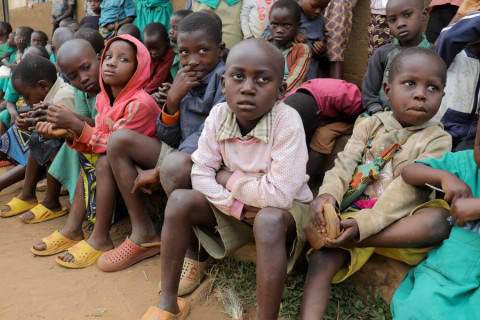
In the Democratic Republic of the Congo, fewer than one in four children are registered at birth. In Chad, the figure is similarly below 25%. In the Central African Republic, it is lower still. According to UNICEF's regional assessment, five of the ten countries with the lowest birth registration rates in the world are in West and Central Africa. The children who are not registered do not exist in any government database. They cannot prove their age, their parentage, or their nationality. They cannot legally inherit property, enrol in school under their own name, or access formal financial services. They are, in the language of development institutions, legally invisible. They are not socially invisible. And that distinction is where the real story begins.
What fills the gap
In the DRC, the Catholic Church, Protestant denominations, and the Kimbanguist Church — the EJCSK, the third-largest denomination in the country — have maintained their own decentralized archives for generations. A baptismal certificate from a parish in South Kivu or a church marriage register from Kasai carries greater practical legitimacy in local transactions than a government document, which is widely perceived as a tool for taxation rather than protection. Local merchants accept parish records as proof of parentage. Traditional chiefs rely on church registers to adjudicate land inheritance disputes. In the eyes of the community, the church archive is the civil registry — because it has been functioning as one for longer than the state has been capable of doing so.
This religious infrastructure has increasingly been supplemented by something newer and more immediate: mobile technology. In communities across the DRC, Chad, and CAR, local neighbourhood councils and extended family networks have created designated, closed messaging groups on WhatsApp to record births, marriages, deaths, and land transactions in real time. Community administrators maintain these channels as living records of local social history. When a land dispute or inheritance question arises, elders convene not over municipal archives — which may not exist, may be days away, or may require a bribe to access — but over the timestamped record in the group chat, cross-referenced against the collective memory of community members who were present. The LSE's Africa blog documented in June 2025 how digital platforms are reshaping power and accountability structures across the continent at exactly this level of community governance.
The Tasdjil model: when the state tries to catch up
The gap is not entirely uncontested. In Chad, UNICEF partnered with the government to develop Tasdjil — a digital birth registration application that works without an internet connection and completes a registration in less than ten minutes. Since its 2022 launch, more than 109,000 registrations have been completed through the app. At a health facility in N'Djamena in 2023, a father received his fourth child's birth certificate within an hour of the baby's birth. His three older children had taken years to register, if they were registered at all. "He was so amazed," Tchibindat recalled. "Because this time, in less than an hour, he has the document."
The DRC launched its own civil registry digitization programme in 2025, with UNHCR and international partners funding efforts to extend registration into provinces where state presence has historically been minimal. These initiatives reflect a recognition that the parallel systems — church archives, WhatsApp groups, community councils — are not a temporary workaround pending the arrival of proper state services. They are structural features of societies that developed functioning governance mechanisms precisely because the state was not providing them.
The fragility that optimism obscures
The parallel architecture is resilient. It is not durable. A church archive that burns in an armed attack — and armed attacks on churches in eastern DRC are not hypothetical — cannot be reconstructed. A WhatsApp group administrator who dies, loses their phone, or migrates to the city takes the record with them. A community that fractures along ethnic or political lines may produce competing versions of the same registry, each recognized by a different faction. The World Bank and ODI have documented exactly these failure modes in community-managed identity systems across fragile states: the social capital that makes them function is also the social capital that, under stress, makes them collapse. This is the structural tension that Tasdjil and the DRC digitization programme are trying to navigate: how to extend the reach of formal registration without destroying the community-level legitimacy that parallel systems have earned over decades. A birth certificate issued by a government that communities distrust, and administered through institutions that require bribes to function, does not automatically replace a baptismal record that has served as proof of identity for three generations. The technology is the easy part. The institutional credibility is not.
What Central Africa's parallel civil registries reveal is not a failure of governance. It is a demonstration that governance, in its most basic form — the management of community identity, memory, and belonging — is something that societies produce for themselves when the state does not. The question for the coming decade is whether the formal state, belatedly arriving with apps and digitization programmes, can earn enough trust to make the two systems work together, rather than simply replacing one with the other.