When governments and economists talk about industrializing Africa, the conversation almost always turns to the same heavy topics: deep-water ports, new railways, and billion-dollar mining concessions. But across Central Africa, a much quieter and more urgent transformation is taking shape. Long before a country can run advanced factories or digital networks, it needs a solid army of electricians, welders, machine operators, and IT technicians.
Without them, all those expensive infrastructure projects are just empty concrete. Recognizing this, regional governments and international partners are finally shifting their funding toward building human skills.
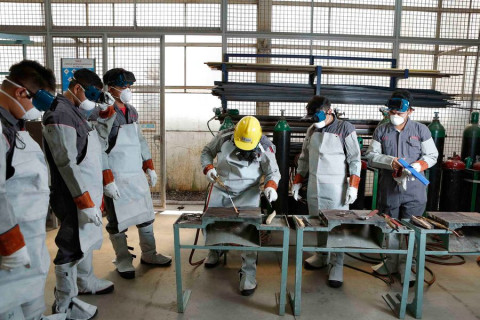
Cameroon is a textbook example. Backed by a €63 million initiative from the African Development Bank (called PEAC), the country is tackling its chronic shortage of skilled labor head-on. Instead of just pushing more students into traditional, academic university tracks, the program is modernizing a dozen vocational centers and setting up nine business incubators. The goal is to train over 7,300 young people in high-demand fields like transport, green energy, and agribusiness—explicitly aligning what is taught in the classroom with what employers actually need.
This isn't just a Western development bank effort either. Partners like Türkiye's TİKA have stepped in to equip workshops and train local instructors, creating a surprisingly diverse ecosystem of technical training. Gabon has taken a different but highly pragmatic route through its PRODECE project, backed by the World Bank. Between 2016 and 2023, the program overhauled nearly 50 training curricula in direct partnership with private companies, providing internships for thousands of students and helping launch over 260 youth-led businesses. The crown jewel of this effort came recently with the opening of two state-of-the-art training centers right inside the Nkok Special Economic Zone—one for advanced wood processing and construction, the other for ICT. By putting the classrooms directly inside an active industrial hub, Gabon ensures students meet their future employers on day one.
Meanwhile, the Democratic Republic of the Congo is gearing up for an even more massive shift. Through a new $300 million World Bank program called SET4Jobs, the DRC plans to train a staggering one million young people over the next five years. A key part of the plan is the creation of the Inga Academy of Excellence—a direct nod to the country's massive hydroelectric potential, where specialized training will finally allow local engineers to manage the nation's energy future. The program targets the very sectors expected to drive the DRC's growth: mining, manufacturing, and the digital economy.
While these projects vary in scale and budgets, they all point to the exact same realization. Technical education is no longer viewed as a second-rate alternative for students who didn't make it to college. It is being treated as core industrial policy.
For decades, the big question for Central Africa was simply: How do we attract foreign investment? Today, a much more practical question has taken its place: Who is going to keep the lights on, fix the trucks, and run the digital networks once that investment arrives? Across the region, the answer has become clear: you cannot build a modern industry until you build the people who can actually run it.