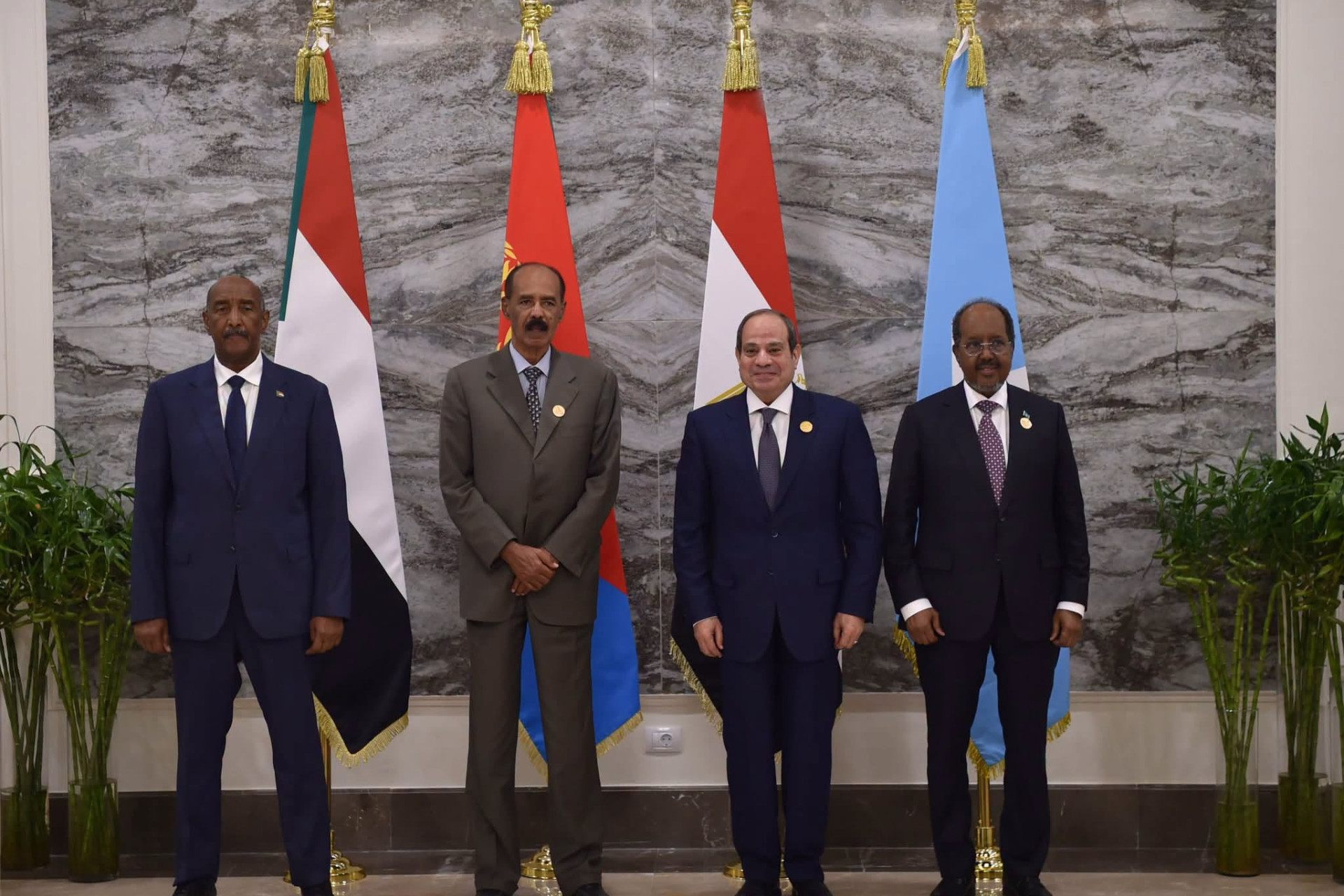
Egypt, Sudan, Eritrea and Somalia have issued a joint declaration committing to closer security coordination, respect for international law on shared rivers and exclusive Red Sea governance by littoral states, amid escalating Horn of Africa tensions.
The quadrilateral consultative summit, convened on October 4 in Egypt’s New Alamein City at the invitation of President Abdel Fattah el‑Sisi, brought together el‑Sisi, Sudan’s Transitional Sovereignty Council chair General Abdel Fattah al‑Burhan, Eritrean President Isaias Afwerki and Somali President Hassan Sheikh Mohamud, according to Daily News Egypt.
In the El Alamein Joint Declaration, the leaders “affirmed their commitment to the fundamental principles and pillars of international law as the basis for regional stability and cooperation”, including respect for sovereignty, independence and territorial integrity, good‑neighborly relations and non‑interference in internal affairs.
The text explicitly backs Sudan’s unity and national institutions, rejecting “the establishment of any parallel entities”. It also reaffirms support for Somalia’s sovereignty and territorial integrity and rejects foreign measures targeting its unity, including recognition of the breakaway region of Somaliland.
On water and maritime issues, the declaration stresses that “Red Sea governance is the exclusive responsibility of its littoral states” while upholding freedom and safety of international navigation in the Gulf of Aden and Bab el‑Mandeb.
It further calls for adherence to international law governing transboundary rivers, including the Nile, and rejects unilateral measures affecting Egyptian and Sudanese water rights.
On the same day, Egyptian, Chadian and Libyan foreign ministers met to discuss counterterrorism, transnational crime and irregular migration, agreeing to work to revive the Community of Sahel‑Saharan States (CEN‑SAD).
The trilateral, which included Egypt’s Badr Abdelatty, Chad’s Ahmat Kogri and Libya’s GNU foreign minister Taher al‑Baour, called for an early ministerial meeting as a step toward a heads‑of‑state summit to resume the bloc’s institutional activities.
The Alamein gathering reflects Cairo’s efforts to strengthen regional diplomacy amid ongoing disputes with Ethiopia regarding Nile water rights and Red Sea security. Egypt seeks broader diplomatic alignment with Horn of Africa partners on shared security interests, emphasizing the strategic importance of cross-border water governance.
Meanwhile, Ethiopia has accused Egypt, Eritrea, and Sudan of supporting opposition rebel coalitions, an allegation all three nations deny. In a statement on October 5, Ethiopia’s Foreign Ministry reaffirmed its “legitimate interests” in the Red Sea and its central role in the Nile basin, rejecting political pressure and “coercive measures” over its regional interests.
It said that virtually all of the Blue Nile, or Abay River, originates in the Ethiopian highlands and contributes about 85% of the Nile’s total flow, adding that “any discussion concerning the utilization and management of the Abay River should be informed by these fundamental realities”.
The ministry also stressed Ethiopia’s geographic and historical ties to the Red Sea, noting that its nearest border is “barely 30 miles (48 kilometers) from the coast.”