The Central African Republic is trying to strengthen its public finances at a moment when the country needs the state to do more, not less. A new World Bank assessment released in July shows just how narrow that room for action remains: domestic revenue mobilization is below 10% of GDP, while the public wage bill can absorb up to 73% of public resources. The result is a fiscal system with too little space for the investments needed in education, health, infrastructure, and jobs. That makes CAR’s fiscal problem more than a question of budget discipline. It is becoming a human-development problem.
Too little revenue, too many demands
The Central African Republic has made progress in public financial management and benefited from improved security conditions, but its ability to finance development remains structurally weak, according to the World Bank’s Public Finance Review. The government continues to depend heavily on external assistance, while domestic revenue remains below 10% of GDP.
The constraint is straightforward. A government that collects relatively little from its own economy has limited resources to allocate among salaries, debt obligations, basic services and development investment. The problem becomes more acute when the public payroll consumes a large share of available resources. The World Bank estimates that the wage bill absorbs up to 73% of public resources, leaving less room for investment and priority social spending. This does not mean public-sector salaries are themselves the problem. A functioning state needs teachers, doctors, administrators, security personnel and other public workers. The challenge is that the cost of maintaining the state can crowd out the investment required to make those workers more effective.
When fiscal weakness reaches the classroom
The consequences are particularly visible in education.
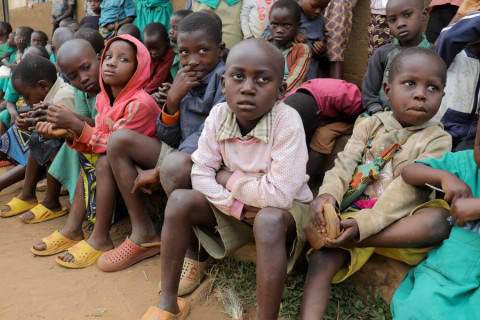
CAR remains one of the world's most fragile education environments, with major gaps in access to schools, teachers and learning materials. The World Bank's current portfolio includes a program specifically aimed at accelerating education results, covering primary and secondary education, teachers, school facilities and access to education. The fiscal constraint therefore has a direct social dimension. Building schools is not enough if governments cannot consistently finance teachers, materials and basic services. Expanding enrollment without strengthening the quality and continuity of education can leave young people formally inside the education system but without the skills needed to enter the labor market.
For a country with a young population and limited formal employment, that gap can become economically and socially costly.
Health is another pressure point
The same fiscal problem appears in healthcare.
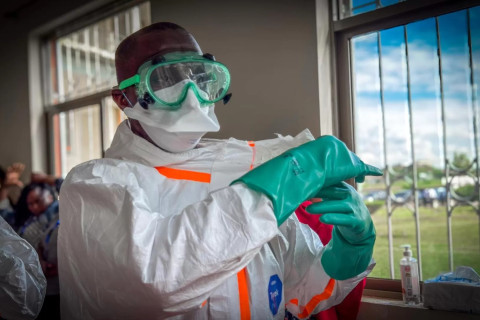
Across Western and Central Africa, the World Bank has warned that health systems are coming under growing pressure as financing tightens while populations grow and disease risks increase. Its 2026 regional health strategy specifically calls for governments to make better use of constrained fiscal space while improving health outcomes, productivity and job creation.
For CAR, the challenge is particularly difficult because limited public resources must support a system operating in a fragile environment. Underinvestment in health does not simply reduce access to treatment. It can lower productivity, increase household costs and make it harder for people to remain economically active.
That creates a feedback loop: weak public finances constrain investment in human capital, weak human capital limits productivity and formal employment, and a smaller productive economy makes it harder to raise domestic revenue.
The untapped resource is inside the economy
The World Bank sees opportunities to break that cycle.
Its Public Finance Review identifies forestry and mining as sectors with significant potential for mobilizing additional domestic revenue. It also recommends broadening the tax base, digitizing tax administration, improving cash and debt management, strengthening transparency and redirecting spending toward priority social sectors. That approach is important because simply increasing taxation is not enough. If new revenue is absorbed by existing expenditure pressures without improving public services, the social return will remain limited.
CAR needs to turn additional revenue into visible improvements in the capabilities of the state: better schools, stronger health services, more reliable infrastructure and conditions that allow private businesses to create jobs.
From fiscal reform to social stability
The connection between public finance and social development is especially important in a fragile country. Where government services are weak or absent, households often compensate through informal networks, humanitarian assistance or private spending. Poor communities have fewer ways to absorb shocks, while young people face limited opportunities to acquire skills or find formal employment. That does not make fiscal reform a substitute for security policy. But it does make public finance part of the country's longer-term stability equation. A stronger fiscal system can give the government more capacity to provide services and create economic opportunities. In turn, better human capital and a larger formal economy can gradually expand the country's own revenue base.
The real test is what the state can finance
CAR’s fiscal challenge will not be solved overnight. The World Bank's recommendations point toward gradual improvements in revenue collection, public financial management, transparency and spending priorities rather than a single solution.
But the direction matters.
For the Central African Republic, fiscal space is not an abstract indicator followed only by economists and creditors. It determines whether the government can maintain schools, staff hospitals, build infrastructure and create the conditions for young people to find productive work.
That is why CAR’s public-finance problem is ultimately a human-development problem. The success of fiscal reform should be measured not only by a stronger balance sheet, but by whether additional public resources translate into better services and greater economic opportunity for the people who depend on the state most.