Africa’s industrial ambitions are running into a problem that cannot be solved by factories, roads, or investment alone: the continent needs enough workers with the skills to operate, maintain, and expand the industries it is trying to build. The timing is becoming increasingly important as governments pursue manufacturing, energy, digitalization, and infrastructure projects while millions of young Africans enter the labor market each year. The World Bank estimates that Africa currently creates about 3 million formal jobs annually, while 10–12 million young people enter the labor force each year.
The challenge is not simply a shortage of jobs or a shortage of education. It is a question of whether the skills produced by education and training systems match the needs of changing economies. Manufacturing, energy, construction, logistics, mining, and digital services require highly specialized technical, entrepreneurial, and digital capabilities, while employers in many African markets continue to report difficulty finding workers with the right qualifications. The World Bank identifies specialized technical and entrepreneurial skills, alongside digital and problem-solving abilities, as very important as automation, digitalization, climate-related changes, and demographic shifts reshape labor markets.
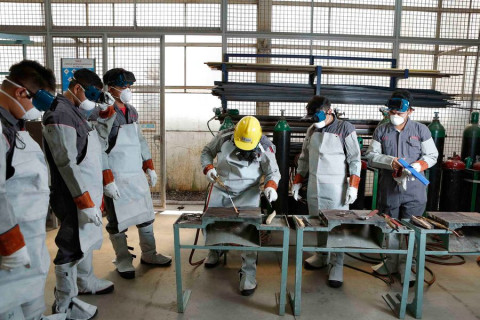
That gap matters because Africa is trying to move into activities that require more than low-cost labor. A new manufacturing plant needs technicians and engineers; expanding electricity networks need electricians, line workers, and maintenance specialists; mining projects need geologists, mechanics, and equipment operators; and digital businesses need workers capable of handling data and advanced technologies. If those skills are unavailable locally, companies have to import expertise, limit the scale of their operations, or invest heavily in training workers themselves.
The problem is becoming even more relevant as Africa attempts to build new industrial and digital capabilities. A recent World Bank report on artificial intelligence warned that developing economies could accelerate their development significantly if they address gaps in power, connectivity, and skills. The report also found that the direct threat of generative AI to employment is currently lower in low- and middle-income economies than in richer countries, creating an opportunity for developing economies to use affordable AI tools to improve productivity in areas such as health, education, agriculture, and business.
But taking advantage of that opportunity requires more than putting technology in people's hands. Workers need the ability to use it productively, while companies need managers and technicians capable of integrating new technologies into existing operations. This makes skills development part of industrial policy rather than simply an education-sector issue.
The scale of the challenge is prompting a broader institutional response. In August, the African Union Development Agency-NEPAD announced plans for a Continental Centre of Excellence for Human Capital and Institutional Development, designed to support stronger links between human capital, institutions, productivity, and economic transformation. The initiative reflects a growing recognition that skills, employment, and industrialization cannot be treated as separate policy areas.
For African governments, the implication is straightforward: attracting an investment project should not be the end of the conversation about employment. The more important question is whether local workers can acquire the skills needed to move from basic jobs into technical, supervisory, and higher-value positions as an industry develops. That requires closer links between companies, vocational and technical institutions, universities, and government programs, with training designed around actual demand rather than qualifications alone.
This is particularly important for Central Africa, where governments are simultaneously seeking investment in mining, energy, infrastructure, and manufacturing. The region has substantial natural resources and large emerging labor markets, but converting those advantages into broader economic opportunities will depend partly on whether local workers can participate in increasingly complex production chains.
Africa therefore faces a skills challenge that is larger than youth unemployment. The continent needs to create millions of jobs, but it also needs to ensure that its workforce is prepared for the jobs generated by its next stage of economic development. Industrialization without skills risks leaving African economies dependent on imported expertise. Skills development without productive industries leaves millions of trained workers without adequate opportunities. The real challenge is to build both at the same time.