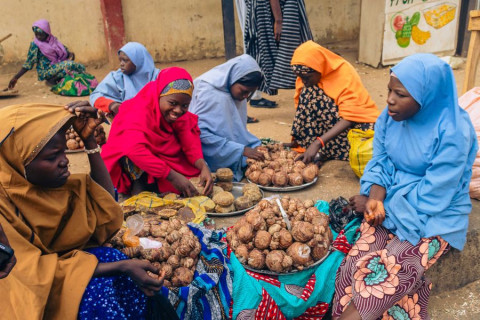
Rural women across Africa are facing a disadvantage that is shaped by both gender and geography. A new Afrobarometer survey covering 38 countries shows that women living outside urban centers generally have less access to education, paid employment, financial services, and digital tools than their urban counterparts. The Pan-Africa Profile, based on 50,961 interviews conducted in 2024/2025, found that 26% of rural women have no formal education, compared with 12% of urban women. Only 39% of rural women have secondary or post-secondary qualifications, while the share among urban women stands at 66%.
Employment reflects much of the same divide. Just 19% of rural women reported having paid employment, compared with 30% of urban women. Women overall also lag behind men, with 25% reporting paid employment compared with 39% of male respondents. In Cameroon, the constraints can be particularly pronounced: 44% of respondents said women are often prevented from working by their spouses or families, the highest share recorded among the 38 countries surveyed.
Access to financial services reveals another layer of the gap. Only 21% of rural women reported having a bank account, half the 42% recorded among urban women. Mobile money is more widely used, but a gender gap remains: 56% of women across the surveyed countries had a mobile-money account, compared with 64% of men. The divide becomes even more visible in digital connectivity. Only 28% of rural women said they access the internet frequently, compared with 62% of urban women.
Control over money is also uneven. Across the 38 countries, 36% of women said they make their own decisions about how to use their financial resources, compared with 44% of men. Rural women were, on average, 11 percentage points less likely than urban women to say that they make these decisions themselves. Women were also more likely than men to report that their spouses determine how financial resources are used.
Political participation offers a more nuanced picture. Rural women reported higher participation than urban women in several conventional forms of political engagement, particularly voting and affiliation with political parties. The pattern does not apply across every form of political activity: participation in activities such as contacting political leaders or taking part in protests can show different results.
Taken together, the findings illustrate what Afrobarometer describes as a “double disadvantage,” where living in a rural area compounds existing gender inequalities. Education, employment, financial access, asset ownership, and digital connectivity all show gaps between rural and urban women, leaving location as an important factor in the opportunities available to them.
The contrast is particularly important as African societies continue to urbanize. Rural communities remain home to a large share of the continent’s population, yet the opportunities available to women within them can differ sharply from those in cities. Afrobarometer’s findings show that the gap is not confined to one area of daily life: it runs from the classroom and workplace to the bank account, mobile phone, and internet connection.