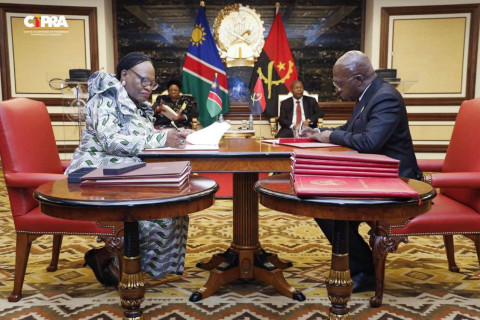
The view from the Kintele Conference Centre, where the African Development Bank held its 2026 Annual Meetings in late May, tells you everything you need to know. The Congo River rolls past just below — wide, brown, carrying enough hydroelectric potential to power much of the continent. More than 3,000 delegates from 81 countries gathered here to discuss how Africa might finally mobilise development capital at scale. Outside the perimeter, the Republic of Congo was running a public debt of 97% of GDP. It's hard to think of a more precise image for Central Africa's core problem.
The theme — "Mobilising Africa's Development Financing at Scale in a Fragmented World" — was not an abstraction. It was a diagnosis. Official development assistance is declining. Risk is priced higher than fundamentals justify. Africa needs more than $1.3 trillion annually to meet its development goals. And yet the continent holds an estimated $4 trillion in pension and sovereign wealth funds — capital sitting in fragments, largely invisible to the infrastructure projects that need it.
The Brazzaville meetings were the first for Dr Sidi Ould Tah, who took office as the ninth AfDB president in September 2025, succeeding Dr Akinwumi Adesina after his two terms. Ould Tah, who previously led BADEA — the Arab Bank for Economic Development in Africa — set the tone early: Africa's growth gives reason for optimism, but "we must remain clear-headed and vigilant." Central Africa's growth ticked up to 3.8% in 2026, buoyed by oil prices. Which is another way of saying the region is still where it has been for decades: dependent on what's in the ground, not what's being built above it.
The UK's Baroness Chapman said the quiet part out loud in Brazzaville: "The scale of ambition that African countries have compared to the amount of investment currently moving into African economies shows a clear mismatch." She then announced £70 million in hybrid capital for the AfDB — roughly 0.2% of what the continent needs annually.
The Congo Basin outside the conference windows absorbs 4% of global carbon emissions every year, providing a climate service worth tens of billions to the planet. The countries of Central Africa have been delivering it for free. The carbon frameworks that might finally monetise it remain largely theoretical. The new African Credit Rating Agency, launched in January 2026, is at least an honest acknowledgement that Western agencies have been overpricing African sovereign risk for years — making borrowing needlessly expensive for governments that can least afford it.
Central Africa left Brazzaville with something it rarely gets: attention. Whether it converts into structural change — or dissolves back into the usual gap between declaration and delivery — is the only question that matters. The river doesn't care either way. It has been flowing toward the Atlantic for millennia. Central Africa's problem has never been a shortage of assets. It has always been the distance between what the region has and what it actually captures from having it.