Across Central Africa, new infrastructure announcements have become almost routine. Governments inaugurate highways, power stations, ports, logistics corridors, industrial parks , and digital networks with growing frequency. International partners continue to finance ambitious construction programs, while official ceremonies often present each completed project as another milestone on the road toward economic transformation.
Yet infrastructure and development are not interchangeable concepts. Building an asset is only the beginning of a much longer process, and the point at which construction begins to generate lasting economic and social value is often far less visible than the ribbon-cutting itself.
This distinction is becoming increasingly important as investment across the region accelerates. Roads reduce travel times, power plants increase generating capacity, and ports improve cargo handling. These are measurable achievements. What proves far more difficult is ensuring that those assets continue operating efficiently years after construction ends, creating broader economic benefits rather than simply existing as completed projects.
The difference lies in what happens after the engineers leave.
Infrastructure rarely functions in isolation. A power station requires transmission networks, maintenance systems, commercial management, qualified operators , and regulators capable of balancing technical performance with financial sustainability. Modern ports depend on customs modernization, logistics coordination, digital systems , and skilled personnel able to manage increasingly sophisticated supply chains. Even healthcare facilities require laboratory networks, trained specialists, procurement systems , and administrative capacity before they become resilient public institutions rather than simply new buildings.
This is where many development strategies begin to encounter their greatest challenge.
Large infrastructure projects are generally financed over decades, and their full economic impact is rarely immediate. Measuring success only months after commissioning risks producing misleading conclusions. At the same time, assuming that physical construction alone will eventually generate development can be equally problematic. Infrastructure creates opportunities, but opportunities must still be converted into productive economic activity through governance, technical expertise , and institutional capacity. That process is often considerably slower than construction itself.
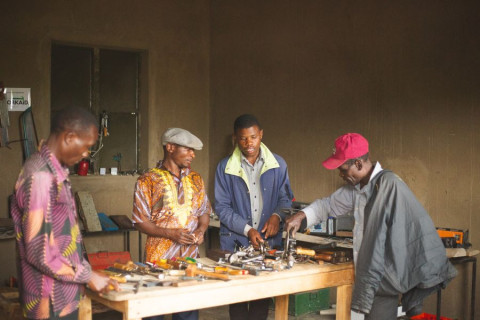
Increasingly, policymakers and development partners have begun to recognize that physical infrastructure and institutional capacity evolve together rather than sequentially. Building technical schools, strengthening regulators, modernizing public administration, expanding research institutions , and developing local management expertise are no longer viewed as secondary priorities. They are becoming integral components of the infrastructure investment cycle itself.
This reflects a broader shift in development thinking. Success is no longer measured solely by kilometers of road completed or megawatts added to the grid. Increasing attention is being paid to operational reliability, maintenance standards, local ownership, regulatory quality , and the ability of national institutions to manage increasingly complex systems without prolonged external support.
For Central Africa, this evolution may prove as significant as the infrastructure boom itself. The region's long-term competitiveness will depend not only on attracting investment but also on building the institutional foundations capable of sustaining that investment over time. Construction can transform a landscape remarkably quickly. Transforming the institutions responsible for operating that infrastructure is a far longer undertaking.
Infrastructure becomes development only when physical assets evolve into systems that create value beyond the structures themselves. Roads matter because they connect markets. Power stations matter because they support industries, schools, and hospitals. Laboratories matter because they strengthen public health systems. Ports matter because they reduce the cost of trade and integrate economies into regional and global supply chains. Their real contribution lies not in the concrete and steel that built them, but in their ability to expand economic opportunity, strengthen institutions, and improve everyday life.
Perhaps that is the more useful way to evaluate development itself. The real measure of success may not be how many projects are built, but how many eventually become self-sustaining systems that continue generating value long after the construction crews have departed and the inauguration ceremonies have faded from memory.