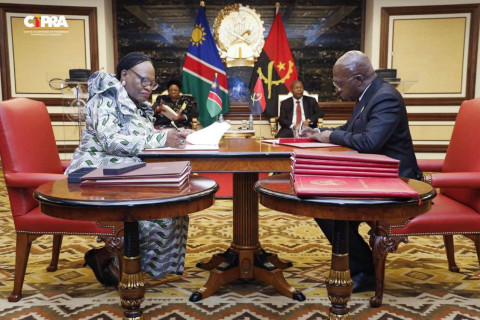
On June 9, 2026, Assistant Secretary-General Martha Ama Pobee stood before the UN Security Council and opened her briefing on Central Africa with something close to good news. "Since our last briefing, the sub-region has passed important milestones," she told the Council, citing the UN's semi-annual report on the region. "These included the holding of critical elections and progress in institutional reforms." By the numbers she was describing, the achievement is real. Gabon has completed its formal political transition following the 2023 coup. Chad has advanced its own post-transition governance-building. Cameroon and the Central African Republic held elections in 2025 that returned incumbents to office. The Republic of the Congo held presidential elections in March, with Denis Sassou Nguesso re-elected on March 15 with 94.82% of the vote, extending a rule that now runs nearly 42 years — though opposition parties reportedly declined to field candidates at all, citing a lack of transparency in the process. São Tomé and Príncipe is preparing for its own vote.
Read individually, each of these is a story about institutional continuity, however imperfect. Read together, in the room where Pobee delivered them, they formed the setup for a much harder second half of her briefing.
The same speech, a very different second half
Pobee did not stop at the milestones. In the same briefing, she warned of increasing restrictions on civil and political rights across the region — shrinking civic space, a phrase that recurred throughout the Council's discussion that day. Panama's representative echoed the concern directly, noting that "the war in Sudan continues to have destabilizing effects for the whole of Central Africa," and drawing the Council's attention to the compounding interaction of climate change, food insecurity, and displacement across the sub-region. The figures behind that warning are stark. Sudan's civil war, Pobee noted, is now in its fourth year. Since it began in April 2023, more than 900,000 Sudanese refugees and 300,000 Chadian returnees have crossed into Chad — a scale of displacement that, as she put it, has "undermined social cohesion in Chad's eastern provinces, exacerbating an already severe humanitarian crisis." That figure sits alongside what we have documented specifically in CAR's Vakaga Prefecture, where more than 35,000 Sudanese refugees have settled around Birao even as the same border region came under a coordinated armed attack at Am-Dafock in June. Chad and CAR are not experiencing two separate refugee crises. They are experiencing the same one, from two different entry points along the same collapsing frontier.
The security architecture built to handle this is fraying
Perhaps the most consequential detail buried in this month's UNOCA reporting concerns the Multinational Joint Task Force — the coalition of Chad, Cameroon, Niger, and Nigeria that has anchored the fight against Boko Haram and ISWAP in the Lake Chad Basin since 2015. Analysts at African Security Analysis describe the force as facing "its most serious capability-commitment gap since the MNJTF's formation," compounded by Chad's own threat to scale back or withdraw its participation — a threat driven by the same pressure we have just described: N'Djamena is simultaneously fighting Boko Haram in the west and managing an overwhelming refugee and security crisis on its eastern border with Sudan. A country cannot indefinitely fight a two-front security emergency at full capacity on both fronts, and Chad appears to be reaching the point where something has to give.
Meanwhile, the insurgent groups the MNJTF was built to contain are not standing still. The same analysis describes Boko Haram and ISWAP as demonstrating "not merely persistence but a qualitative leap in battlefield sophistication" — a warning that echoes what we have separately documented about the ADF/ISCAP's parallel evolution in eastern DRC, where sustained military pressure has produced tactical adaptation rather than defeat. Two different insurgencies, in two different corners of Central Africa, are both outpacing the multinational security architectures built to contain them.
A regional body caught in the middle of the crisis it is supposed to manage
There is a further institutional dimension to this that deserves more attention than it typically receives: ECCAS, the region's primary political and economic community, is itself being weakened by the DRC-Rwanda conflict — two of its own member states locked in a war that the bloc has struggled to mediate credibly, given Rwanda's own membership in the organisation meant to provide collective security guarantees against exactly this kind of conflict. UNOCA's own Special Representative has indicated the office is exploring a trust fund specifically to compensate for resource deficits constraining its preventive diplomacy work — a UN regional office, tasked with early warning and conflict prevention across eleven countries, acknowledging it may not have the resources to do that job at the very moment the job has never been more necessary.
What "milestones against a troubling backdrop" actually means
Put the two halves of Pobee's briefing together and the picture that emerges is not contradictory so much as it is precise. Central Africa's governments have, in a formal sense, gotten better at completing electoral cycles and transitions — Gabon's coup-to-election pathway, Chad's post-transition process, CAR's combined December 2025 elections that we covered as CAR's "decisive phase," Cameroon's contested but completed vote, Congo-Brazzaville's uncontested one. These are procedurally real accomplishments, however thin the underlying democratic substance in several cases.
At the same time, the region's actual security and governance capacity — the ability to prevent conflict, absorb displacement, contain insurgency, and mediate between member states — is eroding faster than the electoral calendar is advancing. A government can hold a technically valid election and still be losing ground to Boko Haram. A regional bloc can convene a summit and still be paralysed by a war between two of its own members. A country can complete a political transition and still be forced to choose between fighting an insurgency in its west and managing a refugee crisis in its east, because it cannot resource both simultaneously.
That is the real substance behind Pobee's phrase "important milestones... against a troubling backdrop." It reflects two trend lines moving in opposite directions within the same countries, at the same time — and the UN's own regional office, briefing the Security Council on both trends in a single session, is telling member states plainly that it does not currently have the resources to close the gap between them.