For decades, the military equilibrium along the 1,300-kilometer border separating Chad and Sudan was determined by classic, heavy mechanics: the number of operational technicals, infantry deployments, and the central state’s monopoly on conventional aviation.
But as the war between the Sudanese Armed Forces (SAF) and the paramilitary Rapid Support Forces (RSF) crosses into its fourth devastating year, the geopolitical landscape of Central Africa has been aggressively flattened by an unprecedented technological spillover.
The borderlands of eastern Chad are no longer just a passive humanitarian refuge; they have become an active, saturated theater for cross-border drone warfare. The rapid proliferation of low-cost, uncrewed aerial vehicles (UAVs)—financed by regional resource syndicates and utilizing gray logistics corridors—has effectively dismantled the traditional concept of territorial sovereignty in the Sahel.
The March 18 Escalation: A Doctrinal Shift in N'Djamena
The transition from localized border instability to a high-stakes drone crisis reached a critical breaking point on March 18, 2026. A devastating, unattributed drone strike directly targeted a civilian funeral gathering at a Quranic school in the Chadian section of the border town of Tiné (Wadi Fira Province), leaving 16 civilians dead and dozens mutilated.
The response from N'Djamena was immediate and marked a total doctrinal shift. Rejecting his previous policy of strategic restraint, Chadian President Mahamat Idriss Déby ordered the total and immediate closure of the entire frontier with Sudan. He placed the national military on maximum alert, issuing a standing directive to retaliate against any Sudanese belligerent—specifically citing both General al-Burhan’s SAF and Dagalo’s RSF paramilitaries—violating Chadian airspace.
However, as UN Assistant Secretary-General for Africa Martha Pobee warned the Security Council during her central Africa briefing on June 9, 2026, "repeated cross-border incursions and drone strikes on Chadian military positions risk a further regionalization of the conflict." The state's declaration of maximum alert has done little to stop the autonomous flight paths of these electronic weapons.
The June 2026 Reality: Tiné and the Attrition of Everyday Life
By mid-June 2026, drone operations along the border have evolved from sporadic incidents into a systematic, near-daily reality. On June 4, 2026, Médecins Sans Frontières (MSF) issued a critical medical alert from the ground in Chad, confirming that Tiné Hospital had treated 116 severely wounded patients in less than four weeks solely due to intensifying drone strikes around the adjacent Sudanese town of Tina, which was captured by the RSF in February.
The field reports paint a harrowing picture of tactical shifts:
-
The Target Selection: Strikes are no longer confined to military trenches. On May 24, 2026, a drone strike smashed directly into a busy marketplace cafeteria in Tina, causing a mass-casualty event that overwhelmed Chadian medical infrastructure.
-
The Logistics Blockade: According to UN updates from June 9, continuous drone surveillance and precision strikes have severely damaged crucial transit routes, including strategic hits on the Ardamata bridge in West Darfur, effectively cutting off the primary highway linking the Chadian hub of Adré to El Geneina.
-
The Saturated Sky: The ambiguity of attribution has become a core tactical weapon. While the SAF deploys advanced Turkish-sourced tactical models, the RSF relies heavily on modified commercial and long-range Chinese-manufactured platforms. This technological saturation creates a "blind battlespace" where both sides deflect blame, leaving the Chadian military unable to accurately target the launch pads without risking full-scale interstate escalation.
The Financial Fuel: Gold and the Autonomy of the Trade
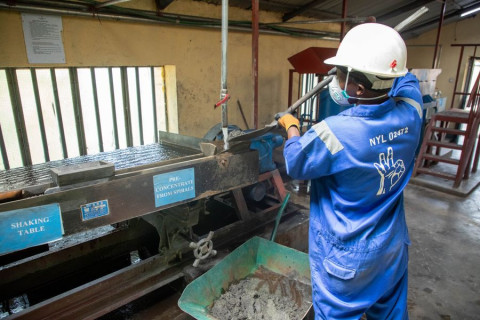
The engine driving this drone inflation is deeply tied to the regional commodity economy. The central corridor of Sudan and the northern mountain ranges of Chad (such as Tibesti and Kouri Bougoudi) remain highly lucrative epicenters for artisanal gold and oil extraction.
As the RSF solidifies its administrative grip over western Sudan, it has systematically leveraged illicit gold exports through gray networks running into transit hubs in North Africa and the Middle East to bankroll its military tech acquisitions.
Because these consumer-grade and agricultural drones arrive labeled as civilian equipment through regional ports, they easily bypass standard military arms embargoes. Once they reach the borderlands, they are stripped, reprogrammed with FPV capabilities, and deployed to protect illegal mining networks, intercept humanitarian aid trucks, or enforce local smuggling tolls. The gold fuels the drones, and the drones protect the gold—creating a completely self-sustaining cycle of conflict that operates totally outside the influence of Western diplomatic sanctions.
The crisis on the Chad-Sudan border in June 2026 demonstrates that the entry barriers to air superiority have dropped to near zero. When decentralized paramilitaries, auxiliary militias, and cross-border syndicates can purchase, modify, and deploy FPV fleets funded by unrefined commodities, traditional border fences become irrelevant.
Chad’s enforcement of maximum alert is a necessary geopolitical posture, but it cannot police a sky filled with cheap, untraceable plastic. Until international security architectures address the raw commodity-for-tech pipelines running through regional transport hubs, the eastern frontier of Chad will remain vulnerable to an invisible, automated war of attrition that is slowly rewriting the sovereignty of Central Africa from above.