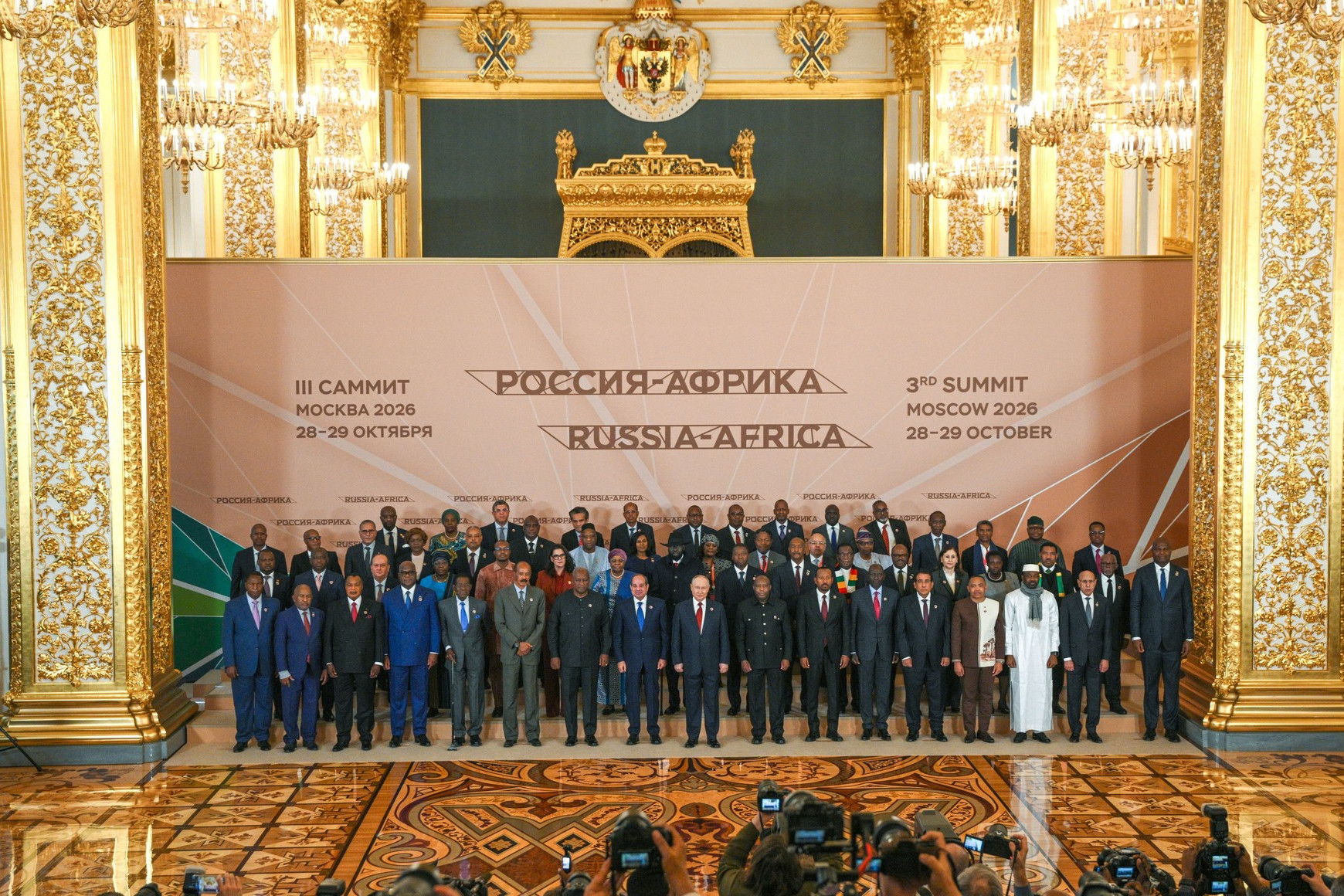
Russian President Vladimir Putin has offered to expand grain and fertilizer supplies to African countries and deepen cooperation in technology, transport and agricultural infrastructure as Moscow seeks to strengthen its economic presence on the continent. However, Russia’s relatively small trade with Africa and the constraints imposed by Western sanctions and the war in Ukraine raise questions about how much of this agenda Moscow can deliver.
Speaking at the third Russia–Africa Summit in Moscow on October 28, Putin presented Russia as an alternative to Western partners, accusing Western countries of exploiting African resources and using debt to hold back development. The two-day gathering brought together delegations from 48 African countries, including 22 heads of state, according to Reuters
Putin said Russia was ready to increase agricultural supplies and expand cooperation in technology, infrastructure and local production. He also called for African countries to process more of their own raw materials, arguing that this could create jobs and generate tax revenue for host governments. These proposals, however, should not be confused with specific funding commitments or completed agreements.
Trade Gap Highlights Russia’s Challenge
Trade figures illustrate the scale of the challenge facing Moscow. Russia–Africa trade exceeded $27 billion in 2025, according to figures cited by the Kremlin. The total remained below Putin’s $40 billion target announced in 2019.
By comparison, trade between the European Union and African countries reached approximately $395 billion in 2025, while China–Africa trade stood at around $348 billion, according to Chattam House. Both relationships are many times larger than Russia’s commercial exchange with the continent.
Agriculture remains a significant part of Russia’s economic engagement. Putin said Russia supplied 13 million metric tons of agricultural products to Africa during the first nine months of 2026 and was prepared to expand deliveries. He also said more than 40 African countries receive Russian grain and fertilizer.
Moscow is seeking opportunities beyond agricultural trade, including energy, mining, nuclear power, manufacturing and transport infrastructure. But expanding these sectors requires more than political declarations: projects need financing, reliable payment channels, commercial partners and sustained investment.
Sanctions Put Delivery to the Test
Western sanctions imposed following Russia’s full-scale invasion of Ukraine in 2022 have complicated some international business, investment and financing operations. Research by the French Institute of International relations has identified sanctions-related obstacles to Russian corporate investment in sub-Saharan Africa, with some companies scaling back their ambitions or withdrawing from projects.
The war itself presents an additional constraint. A Chattam House analysis published ahead of the summit argues that the conflict continues to absorb Russian resources and diplomatic attention, limiting Moscow’s capacity to turn its expanding engagement with Africa into consistent economic results.
These constraints do not mean Russia cannot continue trading with African countries or pursue individual projects. They do, however, raise questions about its ability to finance a broader expansion across infrastructure, technology and industrial production while sustaining its war effort.
For African governments, Russian proposals may offer opportunities to diversify partnerships and access agricultural supplies, technology and expertise. The value of the summit, however, will depend on what follows the speeches: funded projects, signed agreements with clear terms and investments that reach implementation.
Russia’s economic engagement with Africa has expanded in recent years, but its trade remains substantially smaller than the continent’s commercial relationships with the EU and China. The summit gives Moscow a platform to promote its ambitions; whether it can turn those declarations into a larger and sustained economic presence remains an open question.