For decades, Africa's role in the global economy has largely been defined by the export of raw materials. Oil left the continent unrefined, minerals were shipped abroad for processing, and agricultural commodities generated far more value elsewhere than they did at home. Increasingly, however, governments across Africa are beginning to pursue a different model—one that focuses on creating more value before resources leave their borders.
Rather than emerging through a single policy, this shift is becoming visible across multiple sectors. Recent developments in infrastructure, mining, agriculture and industrial services suggest that African governments are placing greater emphasis on domestic processing, local participation and regional value chains.
Infrastructure as Industrial Policy
One of the clearest examples is the Lobito Corridor, linking Angola's Atlantic coast with the Copperbelt regions of Zambia and the Democratic Republic of the Congo (DRC). While frequently described as a railway project, the corridor is increasingly viewed as industrial infrastructure designed to support manufacturing, logistics and mineral exports with greater value addition rather than simply moving raw commodities to international markets.
The recent financial close of the US$753 million financing package led by the U.S. International Development Finance Corporation (DFC) and the Development Bank of Southern Africa (DBSA), part of over US$2.7 billion in committed investments for the corridor, reinforces that objective. Beyond improving transport efficiency, the corridor is expected to support industrial activity along its route and strengthen regional supply chains.
Local Content Becomes Operational
Angola is pursuing a similar strategy through its expanding Local Content policy. Instead of relying exclusively on international contractors, the country is steadily increasing the participation of domestic companies in upstream oil and gas projects. Firms such as Cabship, Copia Group of Companies and Sistran are expanding engineering, logistics and industrial capabilities alongside international operators including SLB and Solar Turbines.
Rather than replacing foreign expertise, the model integrates Angolan companies into project execution, allowing engineering knowledge, technical services and employment opportunities to remain within the domestic economy.
Regional Partnerships Are Becoming More Complementary
The evolution of value chains is also reshaping cooperation between African economies. The recent partnership between Rwanda and Gabon illustrates this trend. Rwanda brings expertise in commercial agriculture and integrated farming systems, while Gabon offers abundant agricultural land with significant development potential. Instead of focusing solely on crop production, the proposed investments combine cultivation, livestock, feed production and agro-processing, demonstrating a growing emphasis on integrated agricultural value chains rather than simple commodity production.
Market Access Alone Is No Longer Enough
Trade policy is evolving in the same direction. China's decision to eliminate tariffs on imports from 53 African countries has expanded market access, but it has also underscored an important reality: tariff preferences alone do not automatically increase exports. Countries capable of processing agricultural products, meeting international quality standards and maintaining efficient logistics networks are expected to benefit the most. For economies that remain dependent on exporting unprocessed commodities, structural constraints continue to outweigh customs preferences.
The lesson is increasingly clear. Market access creates opportunity, but value addition determines who captures the greatest economic benefit.
Congo Raises the Stakes
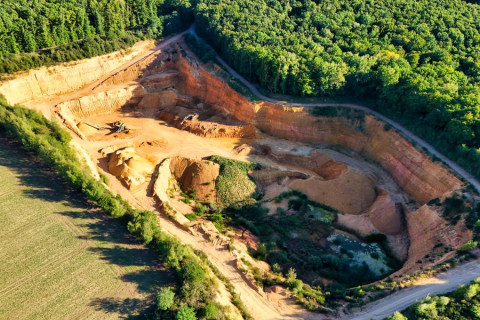
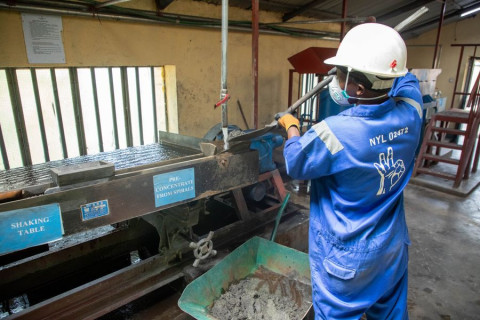
The Democratic Republic of the Congo has taken one of the continent's most significant policy steps toward retaining greater value from its mineral resources by introducing an immediate ban on exports of copper and cobalt concentrates.
According to a government order seen by Reuters, the measure forms part of Kinshasa's broader effort to expand domestic mineral processing and retain a larger share of revenues generated by its mining industry. The reforms also introduce a new tax regime for economically significant mining by-products, with a three-month transition period before the tax measures fully take effect. The decision carries considerable weight. The DRC is the world's largest producer of cobalt and the second-largest supplier of copper, two minerals that have become critical for electric vehicles, battery manufacturing, renewable energy technologies and modern electronics. Mining accounts for roughly half of the country's GDP, which is estimated at over US$70 billion, making any change in export policy economically significant. Whether the measures ultimately succeed in attracting additional investment into refining and processing remains to be seen. But they clearly signal that Kinshasa wants to capture more of the value generated by its mineral wealth before those resources leave the country.
A Different Development Model
None of these initiatives alone will transform Africa's economic landscape. Building competitive industries still requires reliable electricity, transport infrastructure, financing, skilled labour and predictable regulation.
Yet together they point to a broader structural change.
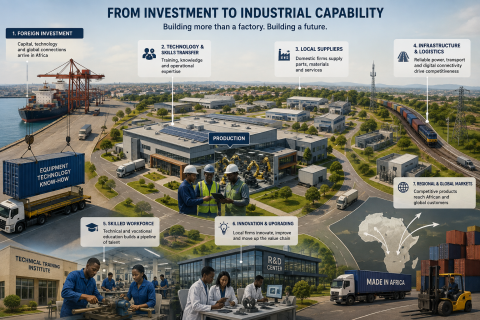
Infrastructure is increasingly designed to support industry rather than simply exports. Local companies are becoming integral participants in major projects. Regional cooperation is moving beyond trade toward production. Governments are beginning to use industrial policy to encourage processing instead of exporting raw materials. For decades, Africa's economic story was largely defined by extraction. Today, an increasing number of governments are attempting to redefine that role. The continent's next phase of development may depend less on producing more resources than on retaining more of the value they create.